
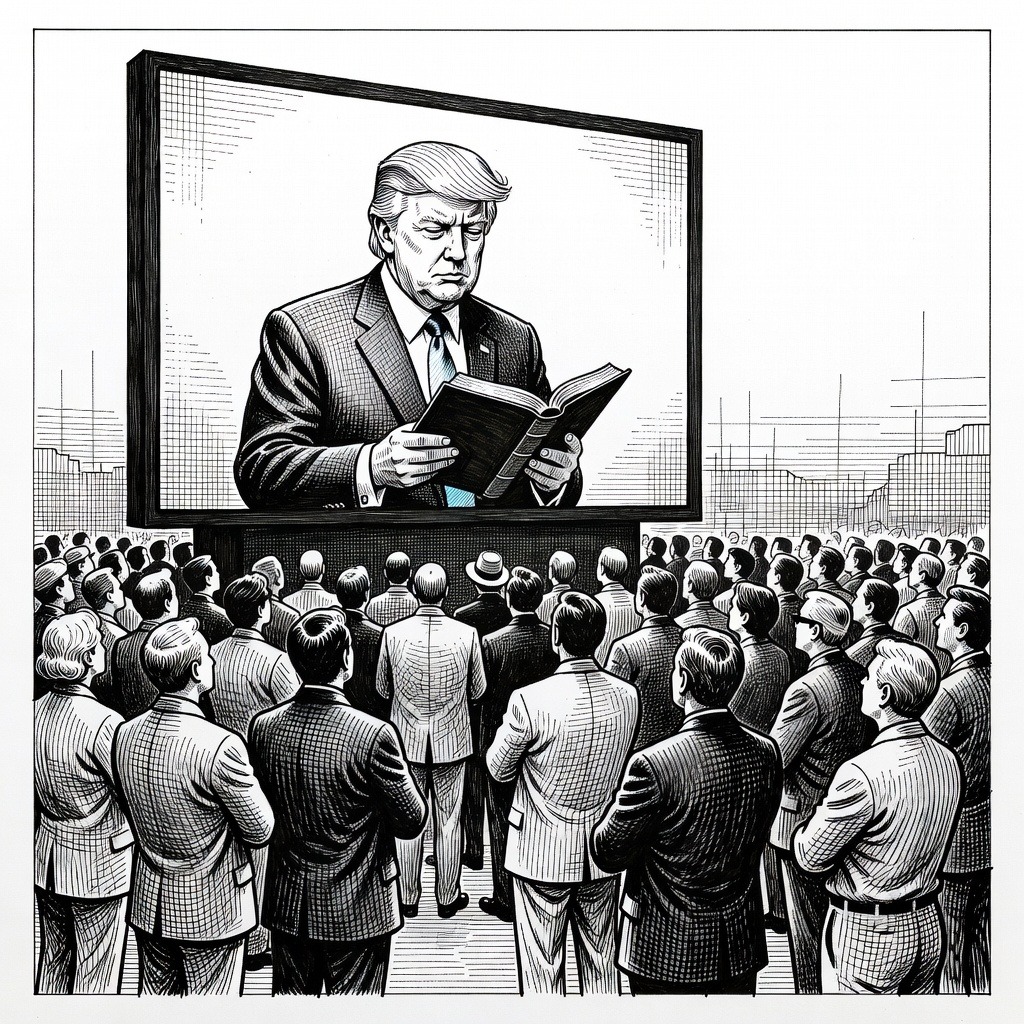
• Breach of Secular Firewall Prioritizing civil liberties and democratic neutrality, this camp views the active participation of high-ranking officials as a dangerous entanglement of church and state. By featuring the President, the Speaker of the House, and cabinet secretaries like Marco Rubio and Pete Hegseth, the government appears to officially endorse a religious agenda. This structural blurring violates the principle that the state must remain a neutral arbiter, transforming a civic space into a platform for government-sanctioned faith.
• Weaponizing Civic Milestones The Reformer perspective sees the framing of the 250th anniversary around "reaffirming the nation's faith" as a historical revision that marginalizes secular governance. Organizations like the Interfaith Alliance interpret this "Rededicate 250" event as a tactical effort to inject a Christian nationalist framework into the American founding narrative. Redefining patriotism through a religious lens undermines the pluralistic reality of the nation by implicitly linking legitimate citizenship with theological devotion.
• Sanctioning Ideological Exclusion This camp fears the long-term normalization of majoritarian religious dominance over minority civil rights. Even with the inclusion of non-Christian figures like Rabbi Meir Soloveichik, the dominant presence of conservative leaders like Franklin Graham and Christian worship music by Chris Tomlin sets a heavily sectarian tone. If state machinery is continuously leveraged to promote these specific religious narratives, it risks alienating non-believers while eroding the egalitarian, secular protections of the Constitution.
How it may affect me
As a U.S. reader:
• In the short term, citizens can expect upcoming 250th anniversary events to feature more prominent Judeo-Christian messaging, which will likely shift the tone of national civic celebrations.
• The active participation of high-ranking officials in faith events may create long-term precedents that blur the separation of church and state, potentially altering the secular neutrality of public spaces and government proceedings.
• The public may experience a shift in the cultural landscape where faith-based initiatives are increasingly used by the government to foster moral cohesion, which could practically alienate non-religious individuals from participating in civic life.
• Long-term legal and political interpretations of civil liberties could be impacted as leaders increasingly promote the philosophy that individual rights are derived from a Creator, a framework intended to restrict the government's ability to arbitrarily revoke those rights.