
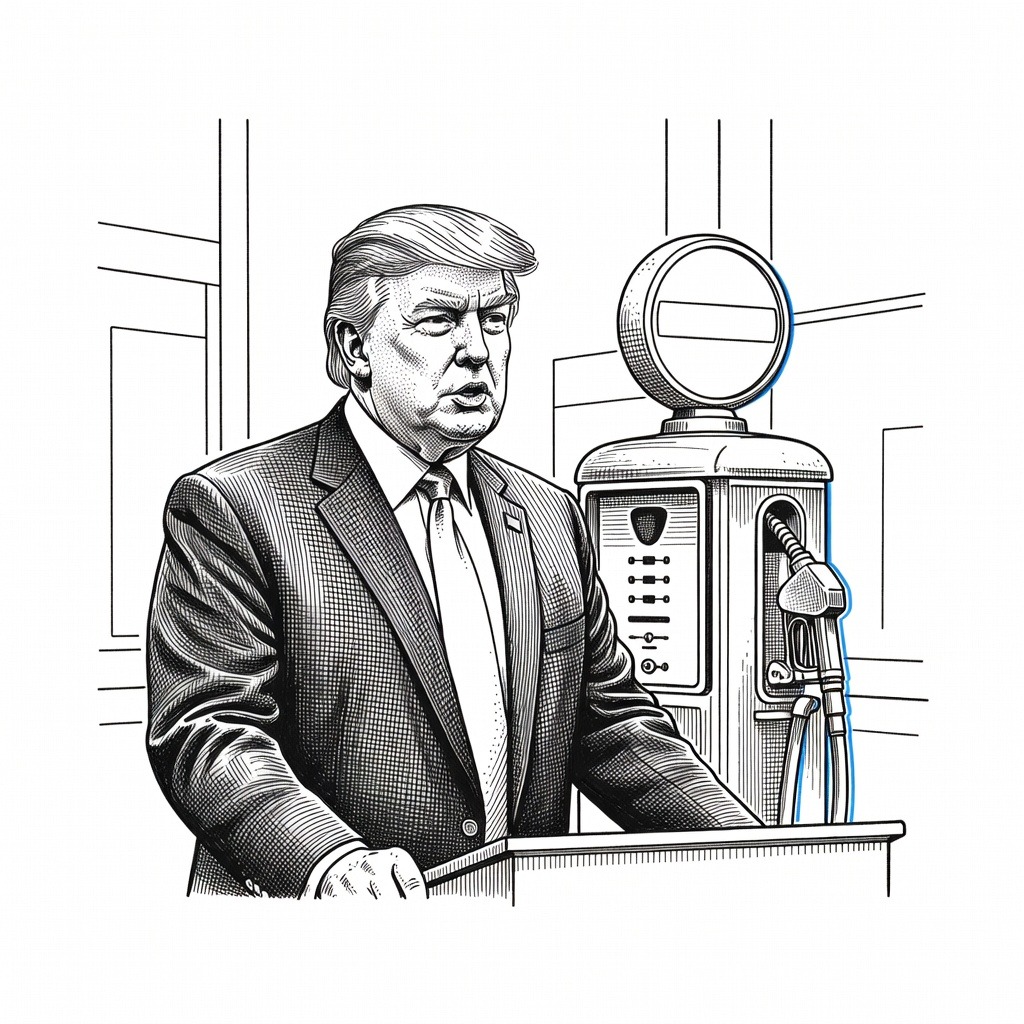
AI-generated illustration. Visual interpretation does not represent real individuals or scenes.
President Trump Proposes Temporary Suspension of Federal Gas Tax Amid Rising Fuel Prices
2026-05-11
The BareStory
President Donald Trump has proposed a temporary suspension of the federal gasoline and diesel taxes to offset surging fuel prices linked to an ongoing conflict with Iran. Average U.S. gas prices recently reached approximately $4.52 per gallon, rising by more than $1.50 since the war began in late February.
The federal excise tax currently stands at 18.4 cents per gallon for gasoline and 24.4 cents for diesel. Trump stated he intends to lift the tax and phase it back in once fuel prices decline. Analysts note that a suspension would provide modest savings for individual drivers while costing the federal government an estimated $2.1 billion per month. This loss in revenue would impact the Highway Trust Fund, which finances roadway construction and transit projects.
A federal tax suspension requires approval from Congress, where lawmakers from both parties have indicated plans to introduce or support related legislation. At the state level, Georgia, Indiana, and Utah have already moved to waive their local fuel taxes, which experts suggest can offer more substantial financial relief to drivers.
Market analysts attribute the sustained high fuel prices to the overseas conflict and Iran blocking access to the Strait of Hormuz. Amid the broader economic impact, Trump rejected the prospect of a bailout for U.S. airlines, asserting that the carriers are not performing poorly despite rising jet fuel costs. Additionally, the president characterized a recent peace proposal from Iran as unacceptable, claiming its concessions regarding its nuclear program were insufficient.
Left Perspective
Starving Critical Public Infrastructure
Masking Corporate Price Extraction
Enforcing Fair Institutional Burdens
Right Perspective
Lubricating Seized Supply Chains
Empowering State-Level Fiscal Agility
Enforcing Strict Capital Discipline
Left Perspective
• Starving Critical Public Infrastructure
Prioritizing structural equity requires protecting the long-term public assets that working-class citizens rely upon daily. Stripping an estimated $2.1 billion per month from the Highway Trust Fund directly threatens essential roadway construction and public transit projects across the nation. This framework views the tax pause as a regressive trade-off, sacrificing durable, job-creating public goods for a mathematically modest 18.4-cent reduction that ultimately transfers the hidden costs of decaying infrastructure onto vulnerable communities.
• Masking Corporate Price Extraction
Consumer advocates view temporary tax holidays as highly susceptible to corporate capture during periods of severe supply scarcity. Because the $1.50 price surge is fundamentally driven by overseas conflicts and the Strait of Hormuz bottleneck, energy conglomerates are perfectly positioned to absorb the waived 18.4-cent gas and 24.4-cent diesel taxes into their profit margins without lowering the $4.52 retail price. Consequently, this policy functions as a shadow subsidy for the fossil fuel industry rather than delivering guaranteed financial relief to struggling drivers.
• Enforcing Fair Institutional Burdens
Guarding against institutional extraction demands that highly capitalized corporate entities absorb the consequences of geopolitical volatility rather than passing their risks to the taxpayer. Denying a bailout to U.S. airlines perfectly aligns with this equity framework, ensuring carriers manage their own rising jet fuel costs rather than relying on federal parachutes. However, by rejecting Iran's peace proposal, the administration guarantees the prolonged macroeconomic pain that drove prices up in the first place, proving that superficial tax gimmicks cannot substitute for the diplomatic de-escalation required to truly stabilize consumer costs.
Right Perspective
• Lubricating Seized Supply Chains
Systemic economic stability relies on rapidly reducing overhead and injecting liquidity during severe, exogenous market shocks. Waiving the 18.4-cent gasoline and 24.4-cent diesel taxes provides immediate, friction-free relief to a logistics and freight sector battling a sudden $1.50 per gallon price spike. Removing these artificial government premiums directly limits the compounding inflationary pressures that occur when elevated transportation costs are inevitably passed down to the consumer market.
• Empowering State-Level Fiscal Agility
Market efficiency favors decentralized, localized governance, viewing the federal tax apparatus as a blunt instrument that artificially inflates the cost of living. While the temporary federal pause offers a necessary baseline of relief, the deeper and more effective financial remedies are being executed through agile, state-level tax waivers in Georgia, Indiana, and Utah. This decentralized approach allows local governments to dynamically calibrate their own economic burdens and infrastructure needs rather than waiting on a $2.1 billion federal bureaucracy to act.
• Enforcing Strict Capital Discipline
Preserving market integrity dictates that private industries must independently navigate volatile environments without market-distorting federal interventions. Rejecting the airline bailout enforces necessary fiscal discipline, forcing carriers to innovate and adapt to rising jet fuel costs rather than socializing their operational losses. Furthermore, dismissing an insufficient Iranian nuclear proposal ensures that long-term strategic stability takes precedence over short-term market appeasement, prioritizing the enduring security of vital shipping lanes like the Strait of Hormuz over temporary diplomatic compromises.
How it may affect me
As a U.S. reader:
• In the short term, you may save up to 18.4 cents per gallon on gasoline if Congress approves the federal tax suspension, although consumer advocates warn energy companies could absorb this tax break instead of passing the savings on to retail prices.
• You could see more immediate and substantial relief at the pump if you live in states like Georgia, Indiana, or Utah, which have independently waived their local fuel taxes to bypass federal bureaucracy.
• Lower diesel taxes could temporarily reduce overhead for the shipping and freight sectors, which may help limit short-term inflation on the prices of everyday consumer goods.
• Over the long term, your community could experience delays in roadway construction and public transit improvements due to the Highway Trust Fund losing an estimated 2.1 billion dollars in monthly revenue.
• You should expect overall fuel and air travel costs to remain elevated in the long term, as the rejection of an Iranian peace proposal signals continued supply blockages in the Strait of Hormuz, and U.S. airlines will not receive federal bailouts to cover their rising jet fuel expenses.