
Russia and Ukraine Begin Three-Day Ceasefire as Moscow Holds Victory Day Parade

Illustration for: Russia and Ukraine Begin Three-Day Ceasefire as Moscow Holds Victory Day Parade
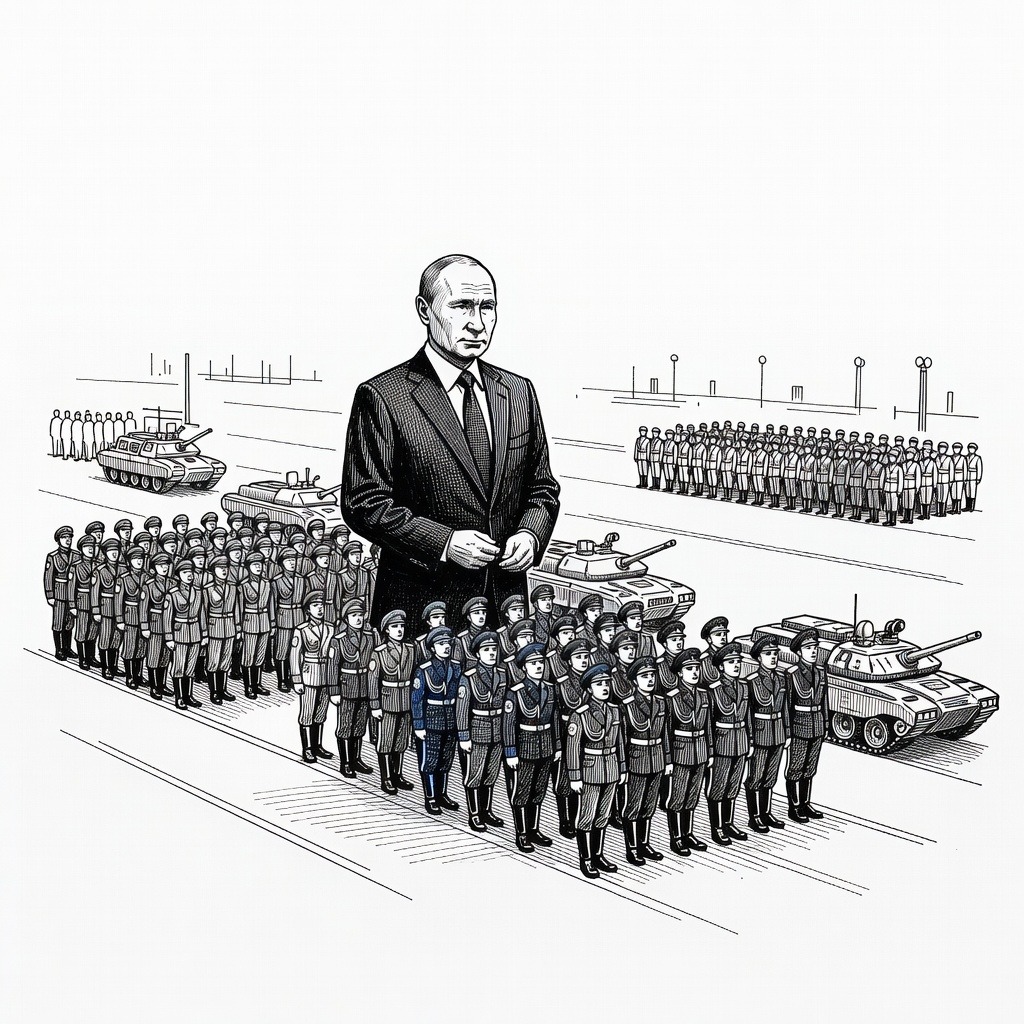
AI-generated illustration. Visual interpretation does not represent real individuals or scenes.

THE BARE STORY

A three-day ceasefire between Russia and Ukraine took effect on Saturday, coinciding with Russia's annual Victory Day celebrations. The pause in hostilities, which extends through Monday, was brokered by United States President Donald Trump and includes a mutual exchange of prisoners.

During a scaled-down military parade in Moscow, Russian President Vladimir Putin stated his belief that the multi-year conflict is nearing its end. He noted that he would only participate in direct meetings with Ukrainian President Volodymyr Zelenskyy once the conditions for a lasting peace agreement are finalized. The parade was notably reduced in size; Russian officials attributed the absence of heavy military equipment to battlefield requirements and potential security threats.

In Kyiv, Zelenskyy confirmed that his administration is preparing logistics for the prisoner transfer. U.S. Special Envoy Witkoff announced that delegations from the U.S., Ukraine, and Russia formally agreed to exchange 1,000 captives per side. Zelenskyy expressed gratitude for Trump's diplomatic involvement and stated his expectation that the U.S. will ensure Russia complies with the truce. Separately, Russian authorities warned that any Ukrainian attempts to disrupt the holiday events would trigger large-scale retaliatory missile strikes on central Kyiv.

Same Facts. Different Perspectives.

Two AI models. Two viewpoints. One factual foundation.

• Validating Leverage-Based Diplomacy Championing "Peace through Strength," this perspective interprets the U.S.-brokered pause as a successful application of hard-power leverage. Inserting American influence directly into the negotiation forces both warring parties to temporarily abandon zero-sum battlefield tactics for structured, superpower-managed stabilization. By taking responsibility for Russian compliance, the U.S. establishes itself as the indispensable guarantor of order, effectively freezing the conflict on terms dictated by American strategic interests.

• Exploiting Adversarial Operational Exhaustion Assessing the opponent's material reality, the notably scaled-down military parade in Moscow is read as a glaring indicator of severe resource depletion. Putin’s stated belief that the multi-year conflict is nearing its end—coupled with a lack of heavy armor attributed directly to "battlefield requirements"—signals deep structural exhaustion within the Russian military. From a realist standpoint, Moscow's agreement to the truce is driven by acute operational necessity rather than a sudden desire for peace.

• Countering Asymmetric Tactical Coercion Navigating adversarial posturing requires a cold assessment of Putin's refusal to meet Zelenskyy and his maximalist threats against Kyiv. These moves are viewed as calculated efforts to project strength domestically during Victory Day while attempting to preemptively shape the final conditions of a lasting peace agreement. This framework understands that to prevent Russia from dictating a one-sided settlement, the U.S. must maintain a credible, looming threat of consequences if Moscow violates the ceasefire parameters.

How it may affect me

As a U.S. reader:

• There is no significant public impact expected for the general U.S. population, as the event pertains exclusively to foreign diplomatic agreements, overseas humanitarian efforts, and international strategic positioning without outlining any direct practical consequences for American citizens.

Read the story at

Note: All TheBareNews content is AI-generated. For additional context, reporting, and updates, you are invited to explore the news outlets linked above.