
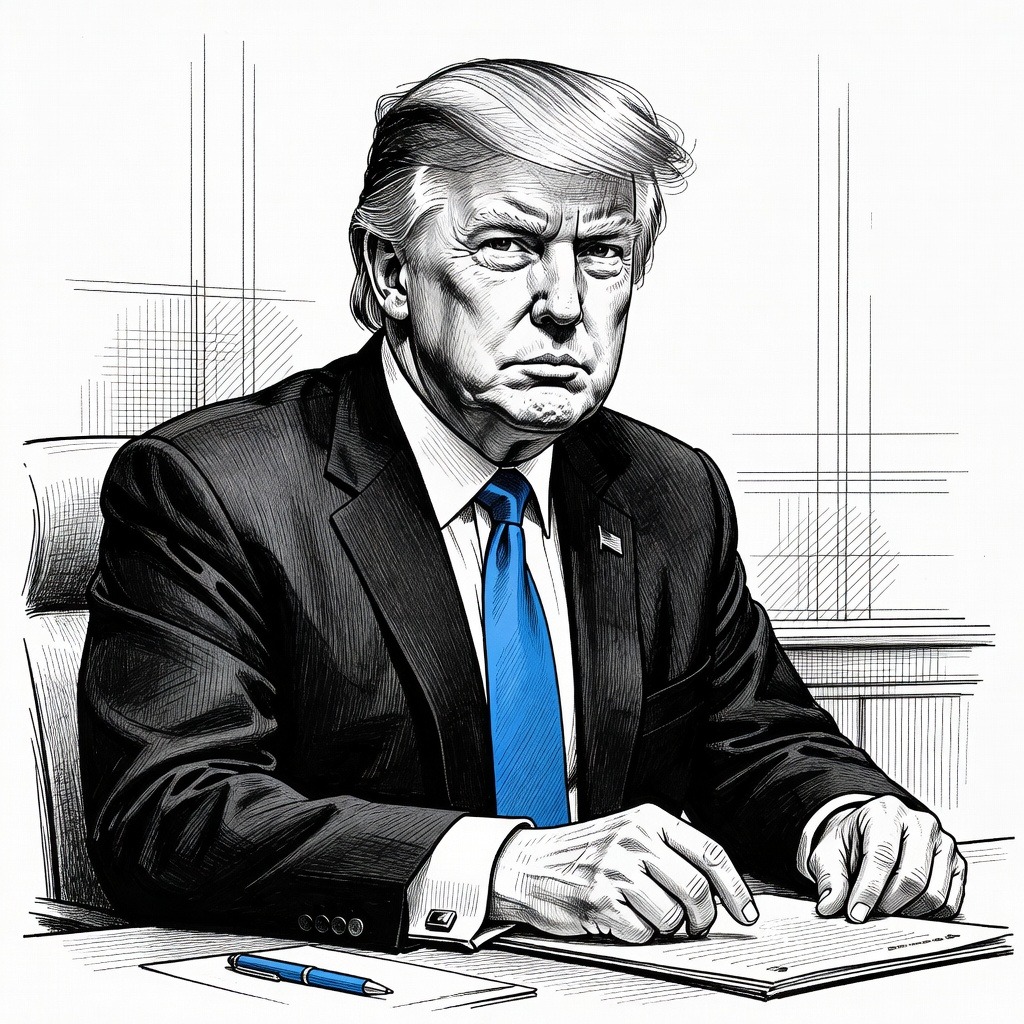
AI-generated illustration. Visual interpretation does not represent real individuals or scenes.
U.S. Trade Court Rules President's 10 Percent Global Tariffs Unlawful
2026-05-08
The BareStory
A panel on the U.S. Court of International Trade ruled in a 2-1 decision on Thursday that President Donald Trump's 10 percent global tariffs are unlawful. The policy, implemented in February, was issued under Section 122 of the Trade Act of 1974, which permits a president to impose tariffs for up to 150 days.
The legal dispute centered on the definition of "balance-of-payments deficits" within the 1974 statute. The court majority rejected the government's argument that the terminology is synonymous with modern trade deficits, concluding that the administration had misinterpreted the law. According to the ruling, the administration is ordered to implement the decision within five days and must issue refunds with interest for tariffs paid under the policy.
The lawsuit was initially filed in March by a coalition of states and businesses. While the court granted an injunction specifically for the state of Washington and two small businesses, it dismissed the claims brought by a larger group of states, stating that those states lacked legal standing in the case.
Thursday's decision marks the second time the administration's tariff policies have been invalidated by the judiciary. The Supreme Court previously struck down a prior round of sweeping tariffs, ruling that the administration lacked the authority to impose those initial duties under the International Emergency Economic Powers Act. Refunds are also expected to be issued for businesses that paid duties under that earlier policy.
Left Perspective
Shield Against Unilateral Overreach
Enforcing Strict Statutory Boundaries
Mandating Concrete Financial Restitution
Right Perspective
Preserving Sovereign Economic Defense
Adapting Frameworks to Modernity
Eroding Strategic Executive Authority
Left Perspective
• Shield Against Unilateral Overreach
Accountability demands strict limits on the concentration of executive power. The administration's deployment of 10 percent global tariffs under Section 122 of the Trade Act of 1974 bypassed legislative consensus to unilaterally impose sweeping economic policy. The 2-1 court decision serves as a vital institutional check, ensuring the executive branch cannot wield economic weapons under the guise of emergency statutory loopholes.
• Enforcing Strict Statutory Boundaries
Institutional integrity requires laws to be applied according to their precise legal definitions rather than politically convenient interpretations. By rejecting the administration's attempt to conflate historical "balance-of-payments deficits" with modern trade deficits, the court majority prevented the normalization of executive legal distortion. This textual discipline protects businesses and states from arbitrary, ad-hoc policy shifts disguised as national necessities.
• Mandating Concrete Financial Restitution
True government accountability extends beyond merely halting unlawful actions to providing immediate material repair for those harmed. The court’s strict five-day deadline to issue refunds with interest—mirroring the prior Supreme Court invalidation of tariffs under the IEEPA—demonstrates that unlawful wealth extraction carries a tangible systemic cost. This recurring judicial pushback highlights the long-term necessity of defending economic civil liberties against repeated executive transgressions.
Right Perspective
• Preserving Sovereign Economic Defense
National sovereignty relies on the executive's capacity to decisively shield the domestic economy from international imbalances. The 10 percent global tariffs were implemented in February as a necessary, 150-day mechanism under established 1974 statutes to correct structural trade disadvantages. Invalidating this tool severely restricts the nation's ability to swiftly enforce fair trade and maintain global economic leverage against foreign competitors.
• Adapting Frameworks to Modernity
Institutional continuity requires statutory frameworks to pragmatically address modern threats rather than remaining frozen in outdated paradigms. The administration’s reading of "balance-of-payments deficits" as synonymous with modern trade deficits reflects a necessary adaptation to contemporary economic warfare. The 2-1 judicial rejection prioritizes rigid linguistic originalism over the functional, real-world necessity of protecting domestic markets today.
• Eroding Strategic Executive Authority
Systemic stability depends on a unified national front in global trade, traditionally spearheaded by the executive branch. The consecutive invalidations of tariff policies—first under the IEEPA and now the 1974 Trade Act—create a dangerous pattern of domestic judicial constraint on international strategy. Forcing rapid refunds with interest undermines institutional continuity and signals to foreign adversaries that U.S. economic defense mechanisms are highly vulnerable to internal legal obstructionism.
How it may affect me
As a U.S. reader:
• In the short term, domestic businesses that paid the 10 percent global duties, alongside those impacted by a previously invalidated emergency tariff, will receive financial refunds with interest, directly restoring extracted wealth to those companies.
• Residents and local economies in the state of Washington may experience more immediate regional effects from the ruling, as the court granted a specific legal injunction for that state while dismissing the claims brought by other states.
• Over the long term, domestic businesses and state economies may experience greater stability and fewer sudden policy shifts, as the ruling establishes strict legal boundaries that prevent the executive branch from unilaterally imposing sweeping economic rules.
• Conversely, this repeated judicial limitation on presidential authority could impact the broader public by restricting the government's ability to swiftly implement protective tariffs and maintain economic leverage against international competitors.