
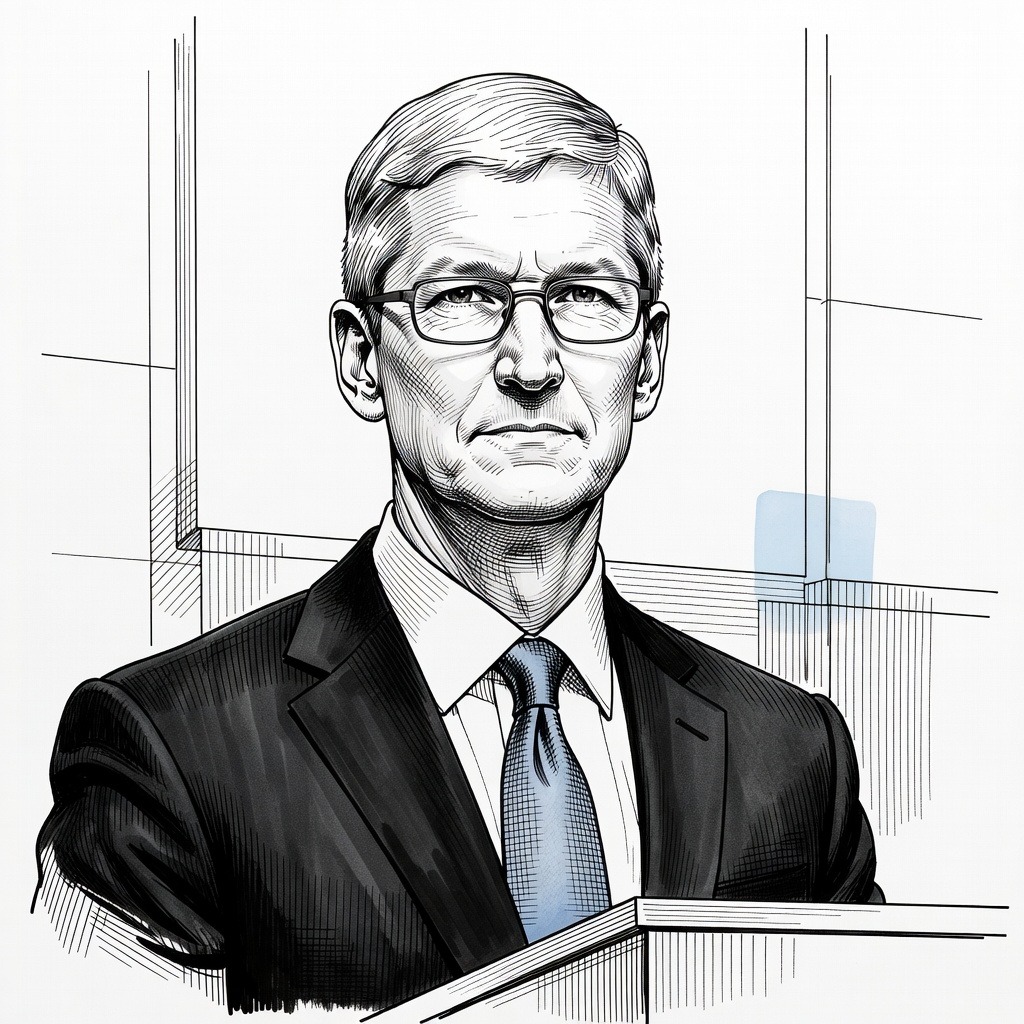
AI-generated illustration. Visual interpretation does not represent real individuals or scenes.
Apple Reports 17 Percent Revenue Growth Amid Upcoming CEO Transition and Memory Constraints
2026-05-01
The BareStory
Apple reported a 17 percent year-over-year revenue increase to $111.18 billion for its fiscal second quarter, alongside earnings per share of $2.01. In response to the results, the company's board of directors authorized a new $100 billion share repurchase program and declared a cash dividend of 27 cents per share. Following the earnings announcement on Thursday, Apple's stock rose in extended trading.
Despite the record March quarter, Chief Executive Officer Tim Cook warned that an intensifying global memory shortage—driven by high demand for artificial intelligence infrastructure—will increasingly impact the business. Cook projected that the constraints and rising memory costs will specifically affect several Mac models in the upcoming quarter. Even with the supply challenges, Apple forecast a revenue increase of 14 to 17 percent for the June quarter, surpassing analyst estimates of 9.5 percent growth.
The earnings release marks Apple's first since announcing a major leadership transition. Cook is set to step down as chief executive to become executive chairman on September 1, ending a 15-year tenure in the role. He will be succeeded by John Ternus, who emphasized his commitment to maintaining the company's financial discipline and executing an extensive product roadmap.
Overall product revenue was bolstered by a 22 percent increase in iPhone sales to $56.99 billion. While Cook described the current smartphone lineup as the most popular in company history, the total slightly missed expectations of $57.21 billion. Services revenue reached an all-time high of $30.98 billion, growing 16 percent. During the report, Cook also confirmed a partnership to utilize Google's Gemini artificial intelligence model to power a personalized version of Siri launching later this year.
Left Perspective
Engine of Wealth Extraction
Consolidating Monopolistic Ecosystems
Vulnerability in Financial Optimization
Right Perspective
Triumph of Capital Efficiency
Strategic Market Adaptability
Anchor of Institutional Continuity
Left Perspective
• Engine of Wealth Extraction
The authorization of a staggering $100 billion share repurchase program alongside a 27-cent dividend payout exemplifies corporate financialization prioritizing investor enrichment over broader economic contribution. Rather than utilizing the $111.18 billion in record revenue to lower consumer hardware costs or invest in supply chain resilience, capital is funneled directly into artificially inflating stock prices. This aggressive reallocation of funds highlights a systemic market flaw where record corporate prosperity concentrates wealth at the top rather than trickling down to workers or consumers.
• Consolidating Monopolistic Ecosystems
Generating an all-time high of $30.98 billion in Services revenue reveals a highly extractive, walled-garden model designed to relentlessly monetize a locked-in consumer base. Furthermore, the decision to outsource the upgraded Siri to Google's Gemini AI signals a troubling alliance between tech behemoths rather than organic market competition. This interlocking of mega-corporations inherently restricts consumer choice and cements global digital infrastructure in the hands of an unaccountable oligopoly.
• Vulnerability in Financial Optimization
Tim Cook’s warning regarding memory constraints on upcoming Mac models exposes the fragility of a hyper-optimized supply chain that prioritizes immediate margins over structural resilience. Incoming CEO John Ternus’s explicit focus on maintaining "financial discipline" suggests the company will likely pass these rising external memory costs directly onto the consumer rather than absorbing the impact. This rigid adherence to profit maximization ensures that everyday buyers will bear the ultimate burden of global AI hardware shortages.
Right Perspective
• Triumph of Capital Efficiency
Delivering a 17 percent revenue increase to $111.18 billion demonstrates exceptional market execution and the profound economic value of producing highly demanded goods. Initiating a $100 billion share repurchase program and a cash dividend is a vital mechanism for rewarding the capital risk taken by shareholders who fund corporate innovation. This disciplined return of capital signals immense corporate health, driving broader market stability and validating the foundational mechanics of free-market prosperity.
• Strategic Market Adaptability
Forecasting a 14 to 17 percent revenue increase for the June quarter—trouncing the 9.5 percent analyst estimate—highlights extraordinary corporate resilience in the face of macroeconomic headwinds. Despite severe global AI-driven memory shortages threatening Mac production, the company leveraged a 22 percent increase in iPhone sales to maintain undeniable upward momentum. Navigating these external supply constraints without sacrificing aggregate growth proves the durability and superior pricing power of a well-diversified product ecosystem.
• Anchor of Institutional Continuity
The structured transition of Tim Cook to executive chairman after 15 years secures critical leadership stability and institutional memory during a period of rapid technological evolution. Successor John Ternus’s commitment to "financial discipline" assures markets that the company will not abandon its successful, margin-protective strategies in pursuit of reckless expansion. Pragmatically partnering with Google's Gemini for AI integration further underscores this fiscal responsibility, efficiently delivering cutting-edge capability without squandering capital on redundant internal R&D.
How it may affect me
As a U.S. reader:
• In the short term, consumers looking to purchase new Mac computers may encounter higher retail prices or limited product availability, as the company's commitment to strict financial discipline suggests the rising costs of global AI-driven memory shortages will be passed directly to buyers.
• Users of Apple devices will experience shifts in their daily digital routines later this year when Siri is upgraded using Google's Gemini AI, requiring consumers to navigate an ecosystem that consolidates technology from two distinct corporate platforms.
• Individuals who hold shares in the company, whether directly or through broader retirement and mutual funds, will likely see direct financial benefits from the newly authorized $100 billion share repurchase program and the 27-cent per share cash dividend.
• Over the long term, everyday users deeply integrated into the company's services and hardware may continue to face firm pricing structures, as incoming leadership plans to prioritize profit margins, capital efficiency, and shareholder returns rather than utilizing record revenues to lower consumer costs.