
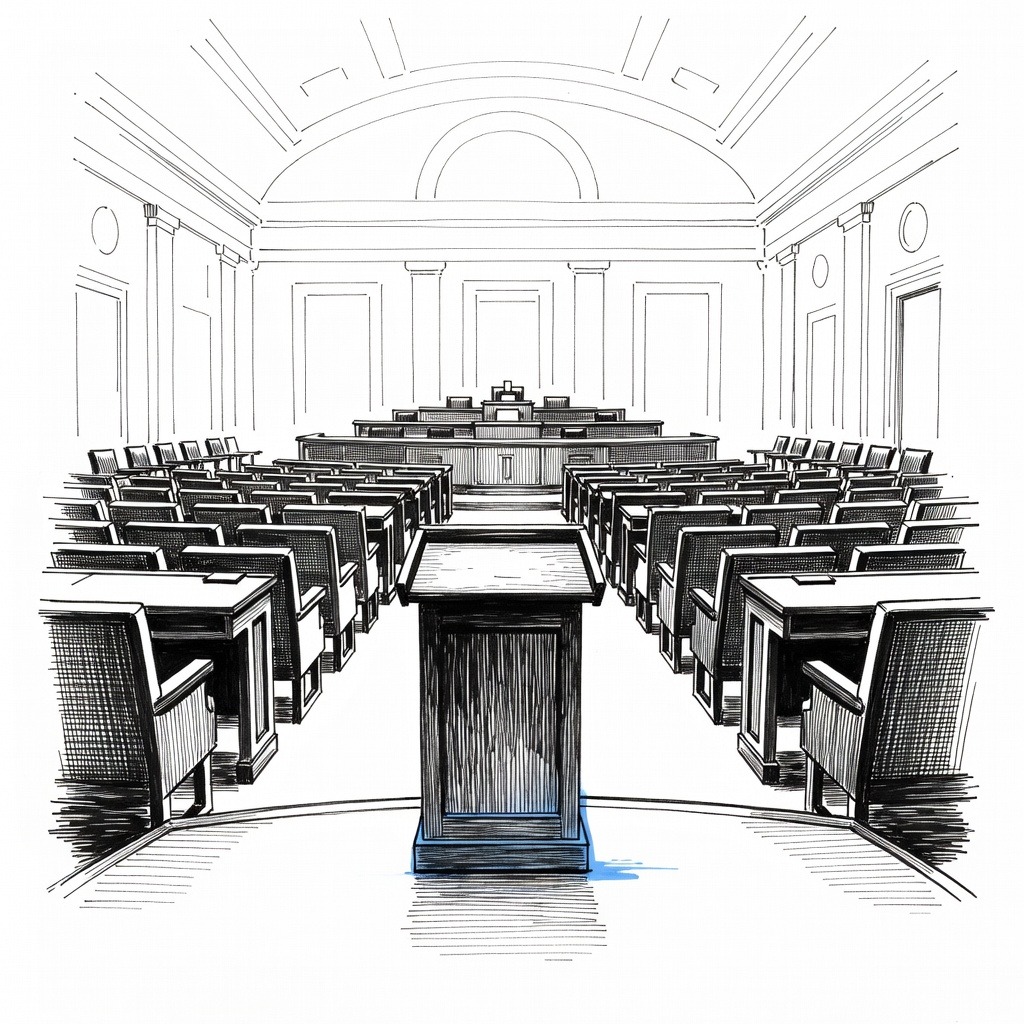
AI-generated illustration. Visual interpretation does not represent real individuals or scenes.
King Charles III Addresses Joint Meeting of Congress During U.S. State Visit
2026-04-28
The BareStory
King Charles III is scheduled to address a joint meeting of the United States Congress on Tuesday afternoon as part of his first state visit to the country. The address follows a Monday reception at the White House, where the British monarch and Queen Camilla met with President Donald Trump and First Lady Melania Trump for an exchange of gifts.
House Speaker Mike Johnson, who extended the invitation alongside other congressional leaders, stated the address is intended to reaffirm the alliance between the two nations ahead of the 250th anniversary of American independence. The afternoon event prompted adjustments to the congressional schedule. House Majority Leader Steve Scalise indicated that planned legislative votes will be delayed until Tuesday evening to accommodate the royal address.
The Capitol visit occurs alongside planned demonstrations regarding the king's brother, Andrew Mountbatten-Windsor, and his connections to convicted sex offender Jeffrey Epstein. Representative Ro Khanna announced plans to hold a roundtable with Epstein victims outside the House chamber. Khanna previously requested a meeting between the king and the survivors, but a lawyer for the monarch stated the king would decline, citing concerns about prejudicing ongoing police investigations in the United Kingdom.
Security for the royal visit remains elevated following a series of recent incidents. The heightened protocols follow a recent shooting and security breach outside the White House Correspondents' Association Dinner, where a suspect was charged with the attempted assassination of President Trump.
Left Perspective
Expose Institutional Complicity
Pierce Diplomatic Shields
Rebuke Ceremonial Sycophancy
Right Perspective
Fortify Transatlantic Alliances
Uphold Jurisdictional Integrity
Enforce Systemic Security
Left Perspective
• Expose Institutional Complicity
Representative Ro Khanna’s roundtable with Jeffrey Epstein victims represents a necessary disruption of unchecked elite privilege. By bringing survivors directly outside the House chamber during a highly publicized state visit, this perspective frames the royal address as a shielding mechanism for powerful figures connected to systemic abuse. Elevating the voices of the vulnerable in the face of archaic pomp serves to challenge a political status quo that routinely prioritizes diplomatic etiquette over human rights.
• Pierce Diplomatic Shields
The monarch’s legal defense—citing concerns over prejudicing ongoing United Kingdom police investigations into Andrew Mountbatten-Windsor—is interpreted as a convenient bureaucratic smokescreen. From this viewpoint, legal technicalities and royal protocols are frequently weaponized by state actors to delay or deny closure to victims of sexual violence. The refusal to meet with survivors demonstrates how institutional power insulates itself from accountability, viewing justice as a secondary concern to public relations.
• Rebuke Ceremonial Sycophancy
House Majority Leader Steve Scalise’s decision to delay scheduled legislative votes to accommodate a foreign monarch exemplifies a systemic failure to prioritize the actual needs of the people. This camp views the extensive congressional schedule adjustments and lavish gift exchanges with President Donald Trump as a misuse of state time and resources. For the reformer, pausing the democratic legislative process to host an unelected sovereign fundamentally contradicts the stated values of a nation ostensibly preparing to celebrate its independence.
Right Perspective
• Fortify Transatlantic Alliances
House Speaker Mike Johnson’s invitation to King Charles III serves as a vital reinforcement of the West's most foundational strategic partnership. Ahead of the 250th anniversary of American independence, hosting the British monarch for an address to Congress and a White House reception with President Donald Trump symbolizes historic reconciliation and institutional continuity. This camp views ceremonial diplomacy as an essential, high-level mechanism for projecting unity, stability, and enduring democratic order on the global stage.
• Uphold Jurisdictional Integrity
The king's refusal to meet with Epstein victims is seen as a necessary adherence to the rule of law and strict legal boundaries. By heeding his lawyer's advice not to prejudice active United Kingdom police investigations into his brother, the monarch acts with appropriate constitutional restraint. For this framework, domestic political actors attempting to force a foreign head of state into an active criminal narrative violates essential diplomatic protocols and threatens the integrity of established judicial processes.
• Enforce Systemic Security
The elevated security protocols surrounding the Capitol visit and the White House are viewed as an absolute necessity for preserving the continuity of government. Following the attempted assassination of President Trump outside the White House Correspondents' Association Dinner, protecting sovereign leaders from domestic or foreign threats must remain the highest civic priority. This perspective views schedule adjustments by congressional leadership not as a distraction, but as a mandatory operational pivot to ensure the safe functioning of national institutions under threat.
How it may affect me
As a U.S. reader:
• In the short term, you may observe a brief delay in the democratic legislative process, as congressional leaders have postponed scheduled House votes until Tuesday evening to accommodate the royal address.
• If you are navigating the Washington, D.C. area, you will likely encounter heightened security protocols and operational pivots around the Capitol and White House, implemented in response to both the state visit and recent security breaches.
• You will be exposed to increased public demonstrations and discourse regarding institutional accountability, driven by a planned congressional roundtable highlighting the voices of Jeffrey Epstein survivors outside the House chamber.
• Over the long term, this diplomatic event is intended to reinforce the strategic transatlantic alliance and project institutional stability as the country approaches the 250th anniversary of American independence.