
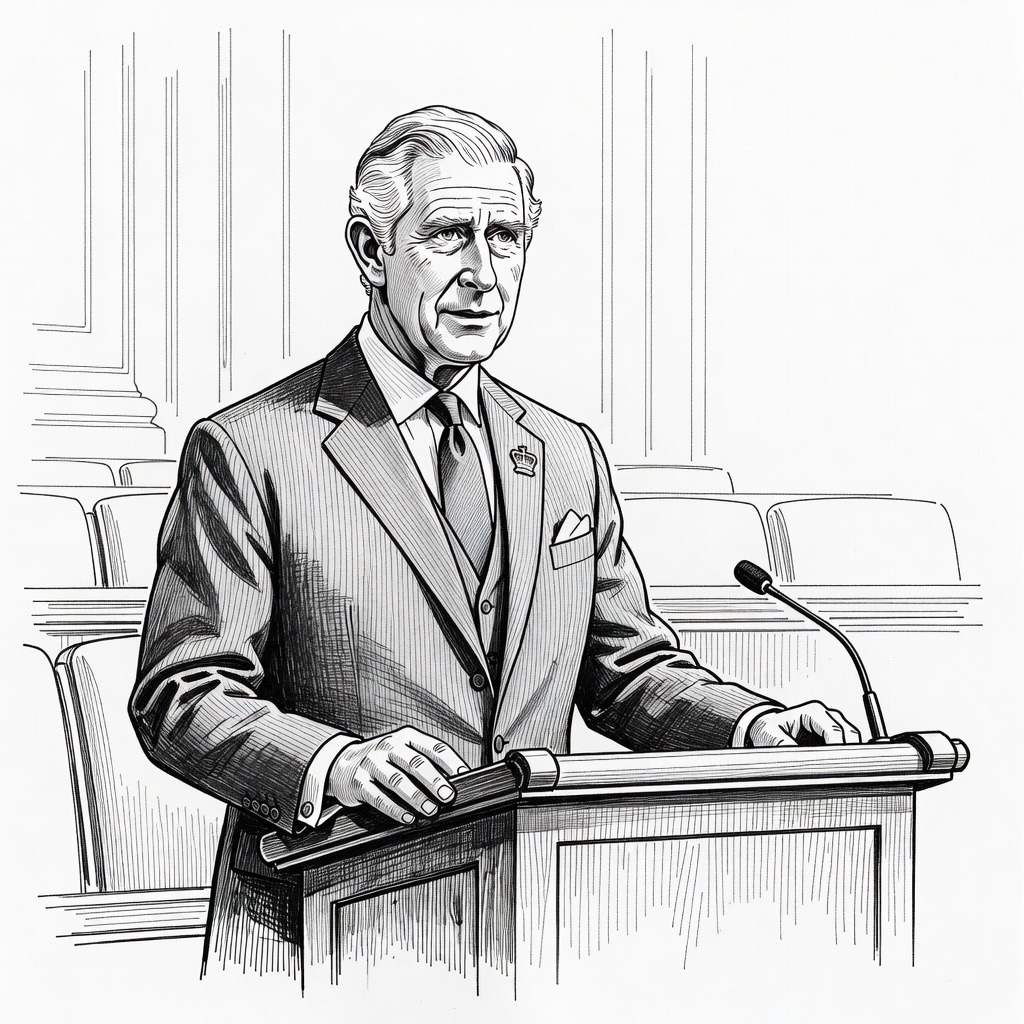
• Shielding Against Unilateral Escalation Prioritizing global stability and international law, this camp views Prime Minister Starmer's initial refusal to allow U.S. base access for strikes in Iran as a necessary diplomatic brake. Rather than a breach of loyalty, this hesitation is framed as a responsible safeguard against impulsive military actions that risk catastrophic humanitarian consequences. The monarch's visit is seen as an essential intervention to repair diplomatic friction without explicitly endorsing unchecked military aggression.
• Anchoring Democratic Soft Power The decision to have King Charles III focus on democratic traditions, the rule of law, and NATO emphasizes that the U.S.-U.K. alliance is fundamentally ideological, not merely a transactional military pact. By reinforcing these shared civic values alongside the 250th anniversary of U.S. independence, the strategy relies on soft power to realign the allied nations. This perspective values institutional continuity and diplomacy as the true foundations for addressing crises in Ukraine and the Middle East.
• De-escalating Combustible Volatility Addressing the recent assassination attempt on President Trump at the White House Correspondents’ Association dinner with politically neutral sympathy serves to cool an intensely polarized environment. The primary fear for this camp is that domestic instability, combined with aggressive foreign posturing, creates a dangerously volatile geopolitical feedback loop. Humanitarian advocates recognize that lowering the temperature through measured, sympathetic statecraft is a strict prerequisite for preventing broader international conflicts.
How it may affect me
As a U.S. reader:
• In the short term, the availability of U.K. military bases for U.S. strikes against Iran will dictate how American military operations are executed, potentially determining whether the nation must rely on riskier unilateral military actions.
• Long-term U.S. national security strategies could shift depending on whether the U.S. and U.K. resolve their tensions through actionable military alignment or diplomatic soft power regarding ongoing crises in Ukraine and the Middle East.
• The focus of the address on trade agreements and democratic traditions may shape future economic policies and international commerce opportunities between the two nations.
• Domestic stability may be directly impacted, as the attempt to project unified international support following the recent assassination attempt on President Trump could help cool the current politically polarized environment and prevent broader geopolitical volatility.