
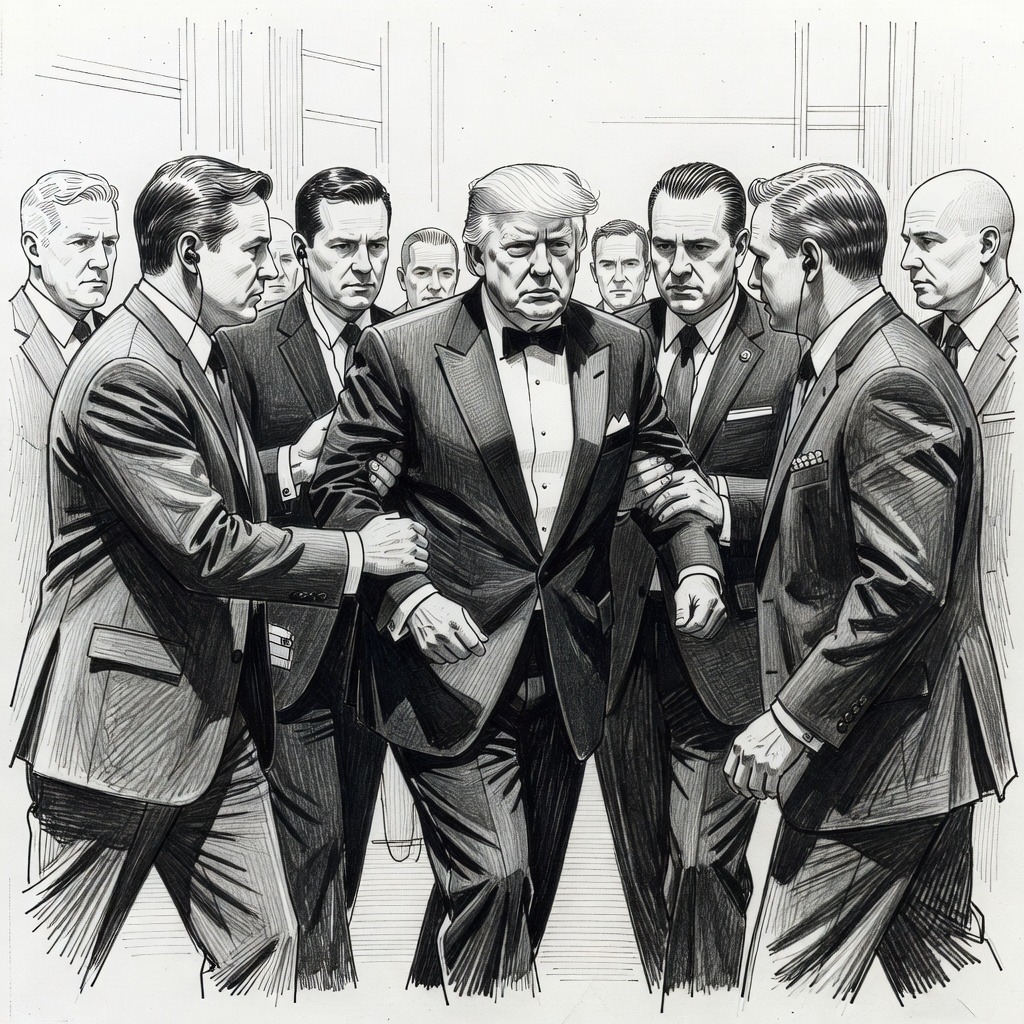
Suspect Charged After Gunfire Disrupts White House Correspondents' Dinner

Illustration for: Suspect Charged After Gunfire Disrupts White House Correspondents' Dinner
AI-generated illustration. Visual interpretation does not represent real individuals or scenes.

THE BARE STORY

On Saturday, April 25, 2026, a security breach and gunfire disrupted the White House Correspondents' Dinner at the Washington Hilton, forcing the evacuation of President Donald Trump and other senior government officials. Authorities arrested 31-year-old Cole Allen, who appeared in federal court on Monday facing charges that include the attempted assassination of the president.

Law enforcement officials stated that the suspect descended an interior hotel stairwell armed with a shotgun, a handgun, and knives before charging a security checkpoint near the ballroom. Secret Service officers tackled the suspect outside the event space. During the confrontation, one agent was struck by gunfire but survived due to a bulletproof vest. Attendees took cover under tables as security personnel quickly escorted the president and his cabinet to safety.

Prosecutors allege that Allen traveled across state lines with the intent to target administration officials. According to authorities, investigators recovered a document the suspect allegedly emailed to his family outlining his plans. Allen, who has not yet entered a plea, was ordered held without bond until a detention hearing on Thursday. Meanwhile, the Federal Bureau of Investigation is continuing to probe the suspect's motives and how he bypassed hotel security protocols undetected.

The breach has prompted an immediate review of presidential security measures. Following the incident, President Trump and the Justice Department renewed efforts to construct a secure, dedicated White House ballroom, arguing the hotel venue is inherently unsafe for top officials. Additionally, the White House press secretary attributed the attack to hostile political rhetoric from the administration's opponents, while the president expressed continued confidence in the Secret Service and called for the annual dinner to be rescheduled.

Same Facts. Different Perspectives.

Two AI models. Two viewpoints. One factual foundation.

• Safeguarding Institutional Continuity The Traditionalist prioritizes the rule of law and views the attempted assassination as a profound assault on the republic's stability. The survival of the President, coupled with the heroism of the Secret Service agent saved by a bulletproof vest, is celebrated as the successful defense of sovereign continuity. For this camp, the swift neutralization of a heavily armed threat at the security checkpoint validates the necessity of robust law enforcement to maintain national order and project unyielding strength.

• Indicting Incendiary Political Climate This camp views social cohesion as fragile and interprets the attack as the inevitable, destructive manifestation of a degraded civic culture. The administration's assertion that hostile rhetoric from opponents fueled this cross-state plot aligns seamlessly with the Traditionalist belief that the sustained delegitimization of leadership breeds physical violence. The emailed manifesto outlining the 31-year-old suspect’s plans is seen as absolute proof that unchecked adversarial rhetoric actively endangers the nation's foundational stability.

• Prioritizing Sovereign Infrastructure The initiative to build a dedicated, secure White House ballroom is embraced as a necessary and pragmatic evolution of state defense. The Traditionalist logic dictates that the physical safety of the executive branch must absolutely override the tradition of hosting events in inherently vulnerable commercial spaces. Hardening the government's infrastructure and ending reliance on civilian hotel protocols is viewed as a vital step to ensure the uninterrupted, secure functioning of the state.

How it may affect me

As a U.S. reader:

• In the short term, the ongoing investigation into how the suspect bypassed hotel protocols will likely lead to stricter security measures and restricted public access at civilian and commercial venues hosting government officials.

• Over the long term, the administration's push to construct a dedicated, secure White House ballroom could shift traditional civic and press events out of commercial spaces, permanently altering how the public and civil society interact with the executive branch.

• The administration attributing the violence to hostile political opponents may impact everyday civic discourse, potentially leading to heightened scrutiny of public political speech and debate over whether such government framing chills legitimate political opposition.

Read the story at

Note: All TheBareNews content is AI-generated. For additional context, reporting, and updates, you are invited to explore the news outlets linked above.