
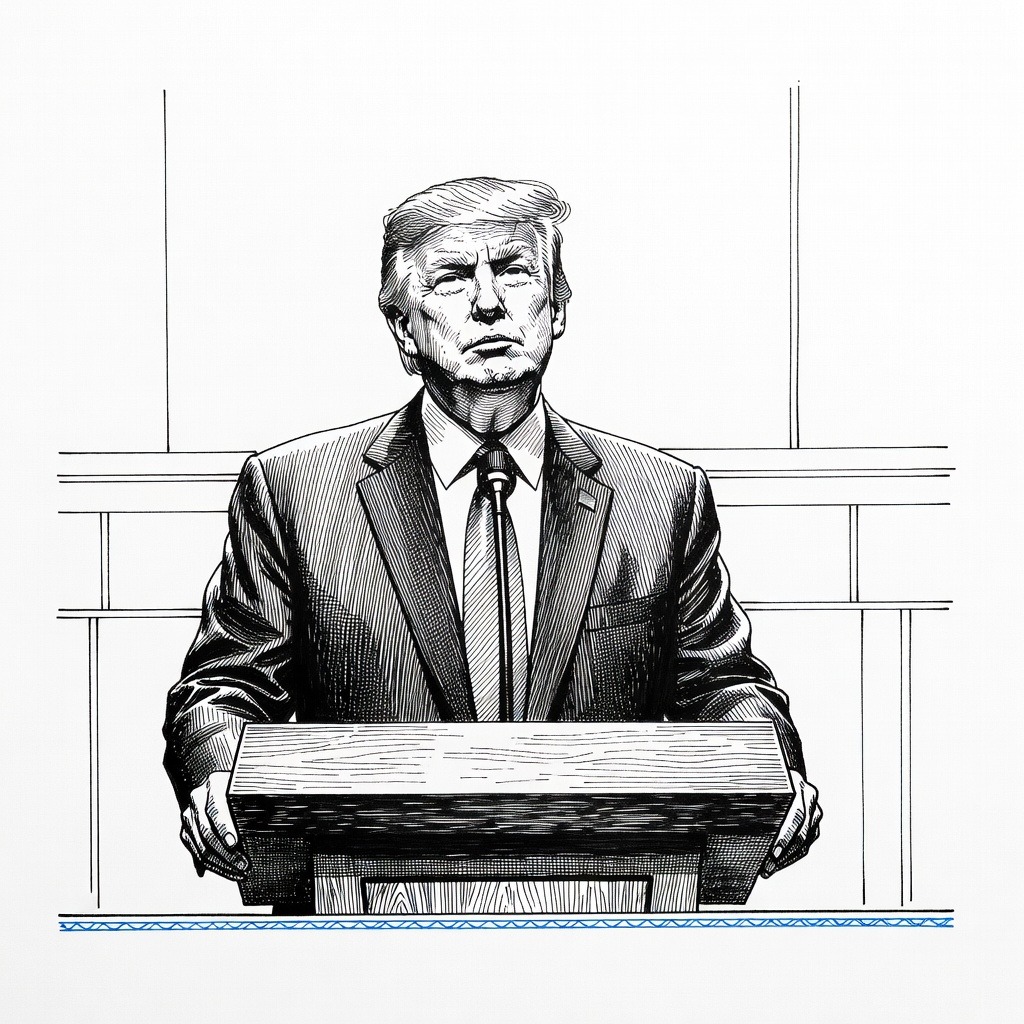
Donald Trump to Attend First White House Correspondents' Dinner as President

Illustration for: Donald Trump to Attend First White House Correspondents' Dinner as President
AI-generated illustration. Visual interpretation does not represent real individuals or scenes.

THE BARE STORY

President Donald Trump is scheduled to attend the annual White House Correspondents' Association dinner in Washington, marking his first appearance at the gathering during his presidency. He did not attend during his first term or the first year of his second term, last appearing as a private citizen in 2015. The president recently announced his acceptance of the invitation, reportedly citing the country's 250th anniversary as a factor in his decision.

The planned appearance highlights an ongoing contentious relationship between the administration and the media, characterized by courtroom disputes over access and instances of officials berating reporters. The president of the correspondents' association stated that the gathering serves to reinforce the First Amendment and the public's need for a free press. However, nearly 500 retired journalists have signed a petition urging the association to demonstrate strong opposition to the administration's actions regarding press freedom.

Ahead of the event, media figures debated how journalists should react if the president uses his platform to criticize the press. Following a published report alleging the president plans to verbally target the media, television host Jim Acosta urged attendees to walk out if retaliatory remarks occur. Acosta claimed his understanding is that Trump intends to criticize attendees and depart before the evening's journalism awards. Former television anchor Katie Couric supported the call for a measured response, stating that laughing at potential insults would reflect poorly on reporters and make them complicit.

For this year's dinner, the organization hired mentalist Oz Pearlman as the featured entertainment rather than a traditional comedian. The White House did not immediately respond to requests for comment regarding the president's planned remarks or the proposed walkout.

Same Facts. Different Perspectives.

Two AI models. Two viewpoints. One factual foundation.

• Honoring National Civic Milestones Institutional continuity and national pride take precedence over localized, partisan media grievances. The president’s decision to finally attend the dinner, explicitly citing the nation’s 250th anniversary, frames the appearance as a fulfillment of historical civic duty rather than a capitulation to the Washington press corps. This approach reflects a commitment to the enduring symbols of the Republic, elevating a major national milestone above the administration's ongoing friction with reporters.

• Challenging Hostile Gatekeepers The executive branch views the institutional press not as a neutral arbiter of facts, but as an entrenched, adversarial political faction. The highly coordinated preemptive resistance—including 500 petitions, walkout strategies formulated by Jim Acosta, and behavioral directives from Katie Couric—validates the perception of an organized media bias. From this perspective, verbally confronting these attendees is a necessary mechanism to bypass elite framing and assert executive authority against a hostile institution.

• Disrupting Elite Media Rituals Preserving the integrity of the executive office requires refusing to submit to the self-congratulatory terms dictated by the media establishment. By skipping previous dinners and reportedly planning to depart before the awards, the president denies the press the traditional submission of a presidential roast. The organizational shift away from a traditional comedian to a mentalist further reflects the fracturing of the old paradigm, indicating that political leaders no longer need to play a subservient role in insular, elite ceremonies.

How it may affect me

As a U.S. reader:

• In the short term, the public may witness a visible disruption during the broadcast of the event, such as a coordinated journalist walkout, which would publicly highlight the adversarial relationship between the media and the administration.

• Long-term, the underlying courtroom disputes over press access that contextualize this dinner could practically affect constitutional transparency and the amount of direct information the public receives regarding executive branch operations.

• Over the long term, the outcomes of these high-profile confrontations could influence public trust in news institutions, either by reinforcing perceptions of an organized media bias or by normalizing government restrictions on the press.

Read the story at

Note: All TheBareNews content is AI-generated. For additional context, reporting, and updates, you are invited to explore the news outlets linked above.