
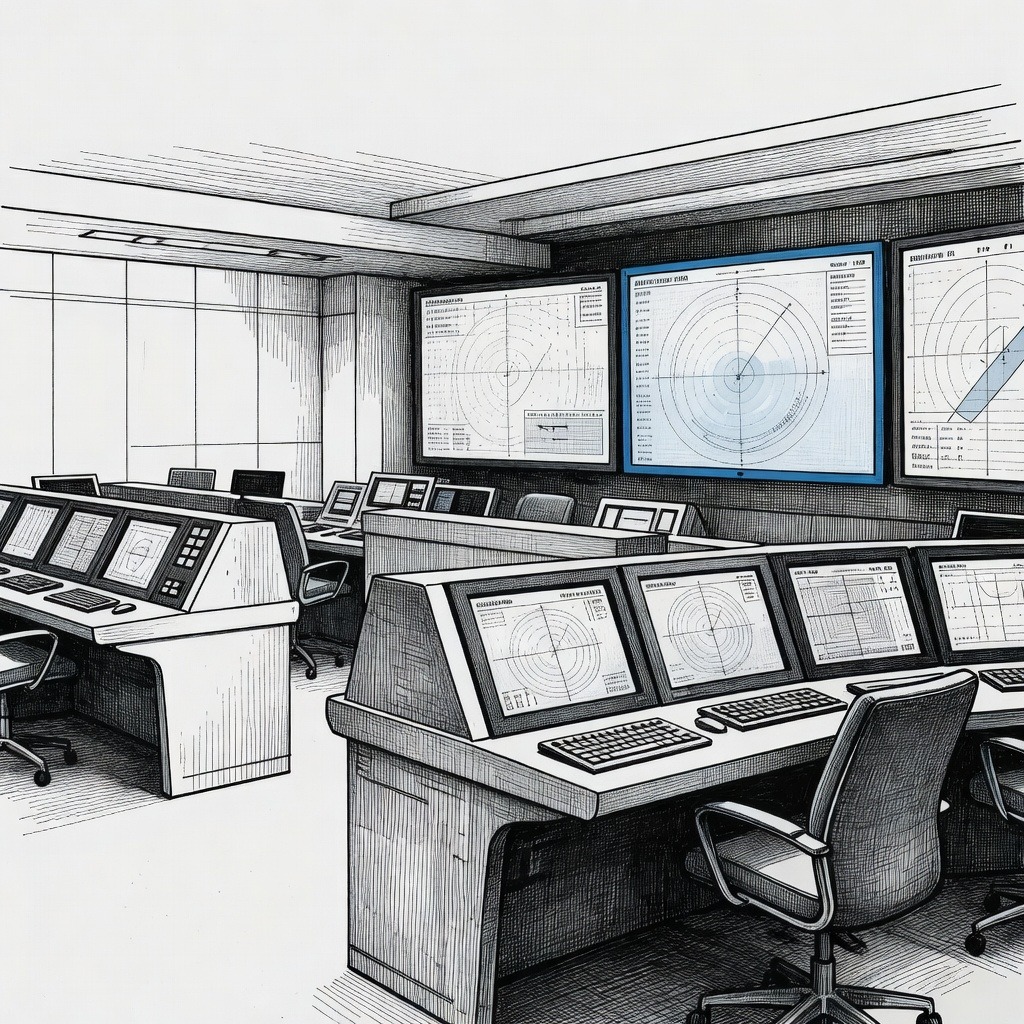
AI-generated illustration. Visual interpretation does not represent real individuals or scenes.
U.S. Officials Advance Digital Upgrades and AI Integration for Air Traffic Control System
2026-04-22
The BareStory
The Department of Transportation and the Federal Aviation Administration are upgrading the U.S. air traffic control network from an analog system to a digital infrastructure. Officials recently requested additional congressional funding to supplement $12.5 billion approved last year. According to Transportation Secretary Sean Duffy, the overhaul involves replacing outdated radar, copper wires, and paper processes with upgraded equipment and fiber optics, with a targeted completion in 2028.
A central element of the modernization effort is the proposed integration of artificial intelligence, which requires an estimated $6 billion to $10 billion in new funding. Duffy stated that AI software would be used to organize flight schedules and predict potential delays up to 45 days in advance. Both Duffy and National Air Traffic Controllers Association President Nick Daniels emphasized that AI will serve as an assistive tool to mitigate errors rather than a replacement for human workers. This technological shift arrives as the FAA faces a reported shortage of air traffic controllers, which agency officials have confirmed plans to address through increased hiring.
Officials assert the cohesive digital upgrades will reduce operational costs, fuel consumption, and block times. The push for modernization also follows several severe aviation incidents. To illustrate the current system's inefficiencies, Duffy cited repeated communication disconnects between planes and controllers at Newark Liberty International Airport last year. Furthermore, recent records highlight fatal air traffic accidents, including a reported deadly collision at New York's LaGuardia Airport last month and a midair crash near Ronald Reagan Washington National Airport last year that reportedly killed 67 people.
Left Perspective
Dismantle the Lethal Status Quo
Shield the Human Workforce
Engineer Predictive Public Safety
Right Perspective
Audit the Expanding Price Tag
Drive Structural Market Efficiencies
Anchor the Technological Transition
Left Perspective
• Dismantle the Lethal Status Quo
Value: Government accountability and protecting the vulnerable. The transition from outdated copper wires to fiber optics is viewed as a moral imperative to correct fatal institutional neglect. The deadly crashes at LaGuardia and Reagan National—which reportedly killed 67 people—expose a crumbling analog infrastructure that actively endangers citizens. Consequently, this camp frames the modernization as an overdue systemic intervention to dismantle a dangerous status quo and protect human life.
• Shield the Human Workforce
Value: Labor protection and social equity. This camp strongly endorses the specific commitment from Transportation Secretary Duffy and NATCA President Nick Daniels to utilize AI strictly as an assistive tool. By prioritizing increased hiring to address the current controller shortage rather than automating jobs away, this framework prevents corporate-style extraction in the public sector. It ensures that technological advancement does not come at the expense of essential workers or vital human oversight.
• Engineer Predictive Public Safety
Value: Proactive governance and consumer advocacy. Funding AI to organize flight schedules and predict potential delays up to 45 days in advance represents a crucial shift toward preventative public service. Securing the additional $6 billion to $10 billion transforms the FAA from a reactionary entity into a proactive safeguard. This preemptive capability is deemed essential to prevent the cascading consumer disruptions and severe communication disconnects recently witnessed at Newark.
Right Perspective
• Audit the Expanding Price Tag
Value: Fiscal discipline and taxpayer protection. The sudden demand for an estimated $6 billion to $10 billion in new funding for AI software triggers immediate scrutiny regarding government resource management. Because this request arrives directly on the heels of a $12.5 billion approval just last year, this framework questions the financial pacing of the 2028 overhaul. Fiscal realists demand strict auditing to ensure this massive capital allocation represents true structural investment rather than escalating bureaucratic bloat.
• Drive Structural Market Efficiencies
Value: Systemic stability and economic velocity. The modernization effort is validated primarily by its capacity to reduce operational costs, curb excess fuel consumption, and optimize block times. Upgrading from outdated radar and paper processes to a cohesive digital infrastructure functions as a critical economic engine. This technological integration streamlines commercial aviation pipelines, directly incentivizing broader market prosperity through reliable, friction-free logistics.
• Anchor the Technological Transition
Value: Institutional continuity and risk mitigation. Integrating advanced predictive AI into a vital national infrastructure network carries significant systemic vulnerability if deployed without restraint. Maintaining human air traffic controllers as the ultimate operational authority serves as a necessary pragmatic fail-safe during this transition. This structured approach ensures that the critical order of the U.S. airspace is not gambled on untested automated systems, prioritizing enduring stability over experimental tech.
How it may affect me
As a U.S. reader:
• In the short term, your tax dollars will fund a major capital investment, as the government is requesting an additional 6 billion to 10 billion dollars for AI software on top of the 12.5 billion dollars approved last year.
• By the targeted 2028 completion, your long-term flight safety is expected to improve as outdated radar and copper wires are replaced with digital infrastructure to prevent the communication failures and fatal collisions recently seen at major airports.
• Your future air travel may involve fewer sudden disruptions, as the newly funded AI systems are intended to organize flight schedules and predict potential delays up to 45 days in advance.
• If you are seeking employment in the aviation sector, you may find increased job opportunities as the FAA plans to hire more air traffic controllers, using AI strictly as an assistive tool rather than replacing the human workforce.
• You may benefit from more efficient commercial flights over time, as the technological transition is designed to streamline logistics, optimize flight block times, and reduce overall fuel consumption.