
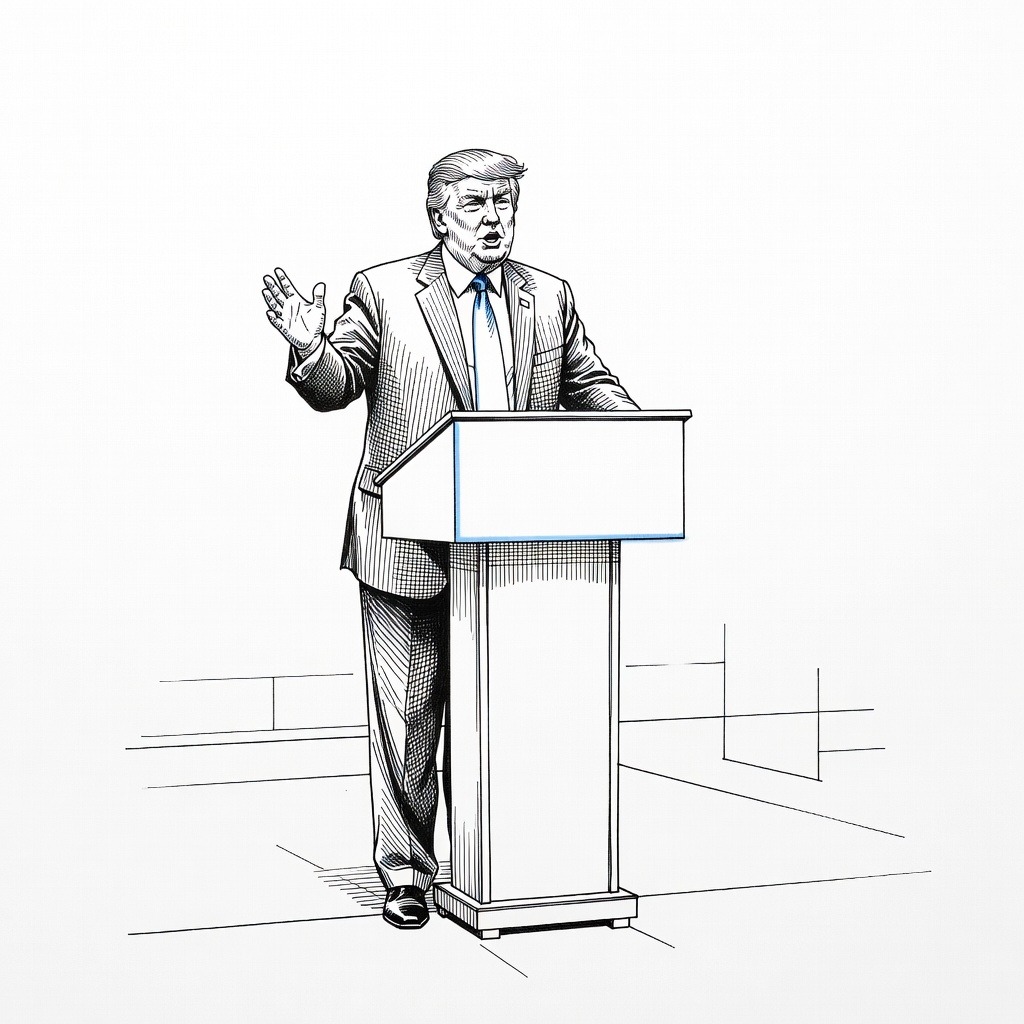
U.S. President Trump Criticizes Italian Prime Minister and Pope Leo XIV Over Middle East Policies

Illustration for: U.S. President Trump Criticizes Italian Prime Minister and Pope Leo XIV Over Middle East Policies
AI-generated illustration. Visual interpretation does not represent real individuals or scenes.

THE BARE STORY

U.S. President Donald Trump has publicly criticized Italian Prime Minister Giorgia Meloni and Pope Leo XIV over their foreign policy stances regarding Iran and the Middle East. The diplomatic disputes highlight differing approaches to the region, as the Vatican advocates for de-escalation and dialogue, while the U.S. president presses allies for stronger measures against Iran.

Trump stated that Pope Leo does not understand Iran's actions and previously labeled the pontiff "weak on crime." The president also claimed that Iran recently killed at least 42,000 unarmed protesters. In response, Pope Leo told reporters he does not fear the Trump administration and remains committed to speaking out against war. Tensions between the U.S. leader and the Vatican also involved a recently deleted artificial intelligence image posted by Trump. While the Vatican and other critics described the image as deeply disrespectful for allegedly depicting Trump as Jesus Christ, the president stated he intended to portray himself as a medical or Red Cross worker.

Following Meloni's criticism of Trump's comments about the pope, the U.S. president accused the Italian leader of lacking courage and allegedly failing to support Washington's efforts to counter Iran. Italian Foreign Minister Antonio Tajani defended the prime minister, stating that an alliance with the United States requires respect and mutual frankness.

Alongside the friction with Washington, Meloni announced the suspension of a long-standing defense cooperation agreement's automatic renewal with Israel. The suspension follows increasing Italian criticism of Israeli military operations and incidents involving Israeli warning shots reportedly fired near Italian United Nations troops in Lebanon. Israeli officials downplayed the pact as largely symbolic, while Israeli opposition leaders criticized the suspension as a diplomatic failure for their government.

Same Facts. Different Perspectives.

Two AI models. Two viewpoints. One factual foundation.

• Enforcing Unified Strategic Deterrence Effective foreign policy in the Middle East requires undeniable strength and actionable measures against hostile actors. Strategic realists view the Vatican’s calls for dialogue with Iran as structurally naive, pointing directly to Trump’s assertion that the Iranian regime recently killed 42,000 unarmed protesters. In this framework, treating a brutal adversary with diplomatic leniency fails to deter future atrocities, making absolute "peace through strength" the only rational approach to containing rogue states.

• Demanding Hard-Power Alliance Cohesion Containing global threats requires allies to act with synchronized resolve rather than fracturing over diplomatic decorum. Trump’s accusation that Meloni lacks the courage to counter Iran stems from the belief that European allies frequently enjoy U.S. security guarantees without sharing the geopolitical risks. Realists argue that prioritizing polite institutional optics—such as the Vatican's outrage over Trump's deleted AI image portraying himself as a medical worker—distracts from the urgent need to project a unified Western front.

• Preserving Vital Security Architecture Severing practical defense agreements over localized tactical disputes fundamentally weakens broader regional stability. Italy’s decision to suspend its defense cooperation agreement with Israel over warning shots in Lebanon is seen as a disproportionate reaction that degrades the allied defense network. Realists align with the Israeli opposition in viewing this suspension as a diplomatic failure, arguing that prioritizing public criticism of military operations over foundational security pacts ultimately benefits mutual adversaries in the Middle East.

How it may affect me

As a U.S. reader:

• There is no significant short-term or long-term practical impact expected for the general public in the United States, as the events described involve international diplomatic friction and foreign alliance disagreements that lack direct domestic consequences.

Read the story at

Note: All TheBareNews content is AI-generated. For additional context, reporting, and updates, you are invited to explore the news outlets linked above.