
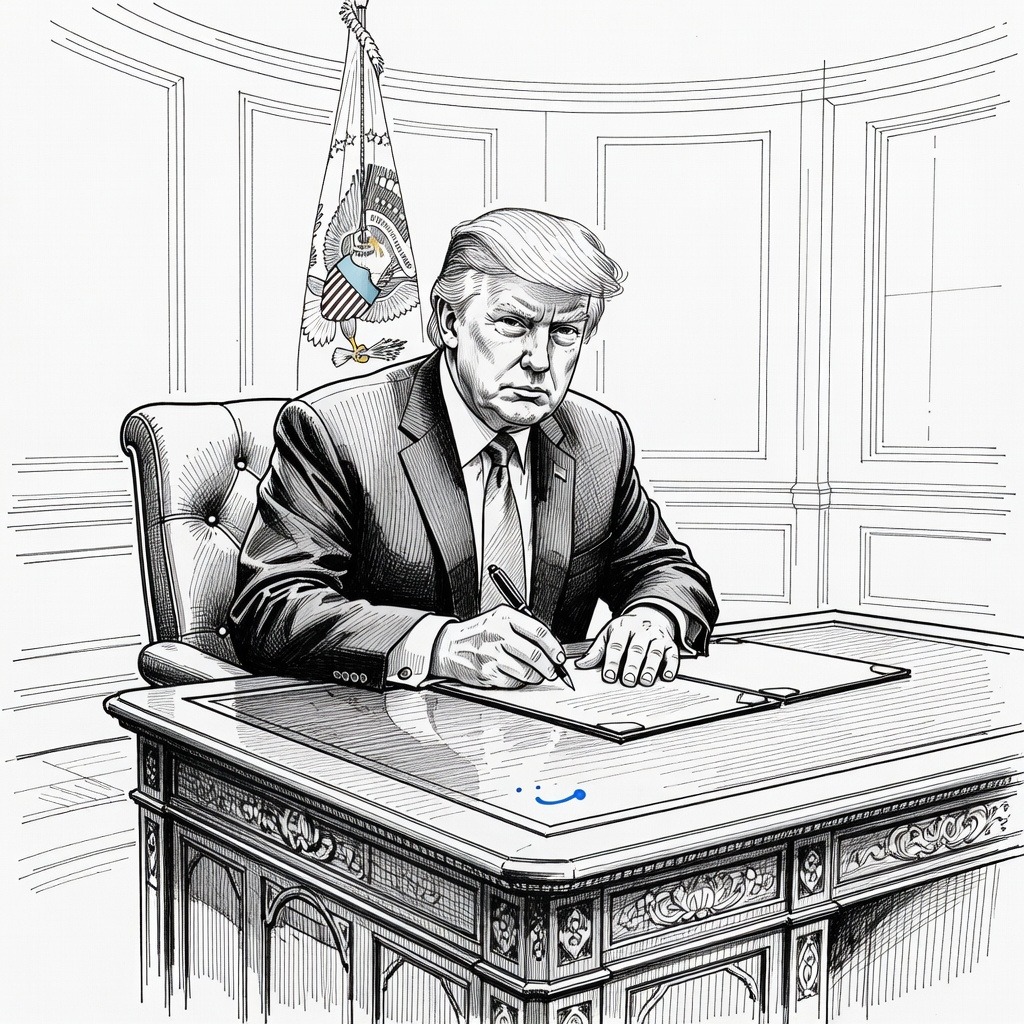
AI-generated illustration. Visual interpretation does not represent real individuals or scenes.
Trump Administration Authorizes Backpay for DHS Employees as Shutdown Continues Through Congressional Recess
2026-04-08
The BareStory
The partial shutdown of the Department of Homeland Security is continuing into its second month as Congress remains on a two-week recess, prompting the Trump administration to issue an executive action to pay affected workers.
On Tuesday, Homeland Security Secretary Markwayne Mullin announced that department employees who have worked without compensation for the past six weeks will receive retroactive paychecks by the end of the week. The payments were authorized by reallocating emergency funds. Mullin warned that the maneuver is a short-term measure, noting that future compensation for non-law enforcement personnel will rely entirely on congressional action. The secretary attributed the prolonged funding lapse to Democratic lawmakers.
Efforts to end the impasse remain stalled while lawmakers observe an Easter and Passover break. Although the White House and several Republican lawmakers have urged President Donald Trump to force Congress back into session, the chambers continue to hold brief pro forma meetings. Supreme Court precedent establishes that these pro forma gatherings count as active sessions, legally preventing the president from compelling lawmakers to reconvene.
The legislative gridlock is tied to disagreements over border security and election legislation. House Republicans have resisted a Senate-approved homeland security funding bill, demanding progress on a budget reconciliation package. Senator Lindsey Graham announced plans to use the reconciliation process to pass border agency funding and provisions of the Safeguarding American Voter Eligibility Act, which would condition state grants on the removal of undocumented immigrants from voter rolls. Senate Minority Leader Chuck Schumer stated that Democrats oppose the legislation, arguing that it acts as a voter suppression measure.
Left Perspective
Masking Legislative Failure
Weaponizing Worker Livelihoods
Shielding Constitutional Boundaries
Right Perspective
Preserving Institutional Continuity
Securing Sovereign Systems
Condemning Procedural Abdication
Left Perspective
• Masking Legislative Failure
Government accountability demands that structural funding issues be resolved through legislation, not unilateral workarounds. Reallocating emergency funds to temporarily cover DHS payroll obscures the fundamental breakdown of the congressional process. By relying on executive maneuverability to issue retroactive checks after six weeks, the administration is treating a symptom while leaving the root disease unchecked. This short-term fix allows Republican leadership to avoid the immediate political fallout of a shutdown while keeping the underlying government malfunction unresolved.
• Weaponizing Worker Livelihoods
Protecting civil liberties requires separating the basic functioning of government from aggressive partisan policy demands. Tying essential homeland security funding to the SAVE Act represents an unacceptable hostage-taking of civil servants to force through restrictive election laws. As Minority Leader Chuck Schumer argues, conditioning state grants on sweeping voter roll purges acts as a direct threat to vulnerable voter access. Holding government paychecks ransom to achieve unrelated voter suppression measures violates the foundational social contract between the state and its employees.
• Shielding Constitutional Boundaries
Maintaining strict separation of powers is paramount when an executive attempts to dictate the legislative process. Utilizing pro forma sessions to prevent a forced reconvening by President Trump is a necessary democratic safeguard against executive overreach. By relying on established Supreme Court precedent, this procedural tactic ensures that the White House cannot unilaterally control the congressional calendar. It acts as a vital institutional barrier, protecting lawmakers from being coerced into passing contested domestic policy under the duress of a presidential mandate.
Right Perspective
• Preserving Institutional Continuity
Maintaining sovereign defenses requires that essential security personnel remain supported regardless of political gridlock. Reallocating emergency funds to guarantee retroactive pay for DHS employees is a pragmatic necessity to ensure national stability. Secretary Markwayne Mullin’s directive ensures that the frontline workers responsible for safeguarding the nation are not financially penalized for congressional dysfunction. Prioritizing the financial stability of these employees after a six-week lapse sustains morale and prevents the degradation of critical law enforcement operations.
• Securing Sovereign Systems
The rule of law dictates that border security and electoral integrity are inseparable pillars of a functioning republic. Integrating homeland security funding with the SAVE Act via the reconciliation process represents a logical alignment of these core national priorities. Senator Lindsey Graham and House Republicans recognize that conditioning state grants on the removal of undocumented immigrants from voter rolls is a fundamental civic duty. This strategy ensures that taxpayer funding for domestic security simultaneously fortifies the established electoral system against unauthorized participation.
• Condemning Procedural Abdication
Effective governance relies on lawmakers prioritizing national security crises over scheduled holidays. The decision by Congress to observe a two-week recess while a federal department remains shuttered is viewed as an abandonment of legislative duty. By utilizing brief pro forma meetings specifically to legally block the president from forcing a return to work, lawmakers are elevating procedural loopholes above national urgency. This reliance on a Supreme Court technicality to avoid active negotiation highlights a severe breakdown in civic responsibility while essential border enforcement funding hangs in the balance.
How it may affect me
As a U.S. reader:
• In the short term, essential homeland security and border operations are likely to remain stable, as retroactive paychecks are expected to prevent the immediate degradation of critical law enforcement services.
• In the long term, public access to non-law enforcement homeland security services may face disruptions, as future compensation for these specific workers relies entirely on stalled congressional action.
• If the proposed funding package passes, state election systems will be required to remove undocumented immigrants from voter rolls to receive federal grants, which could alter local voter registration processes and impact voter access.
• The ongoing legislative gridlock and reliance on executive emergency funds indicate that standard structural funding for domestic security programs will remain unresolved and vulnerable to further delays while Congress is in recess.