
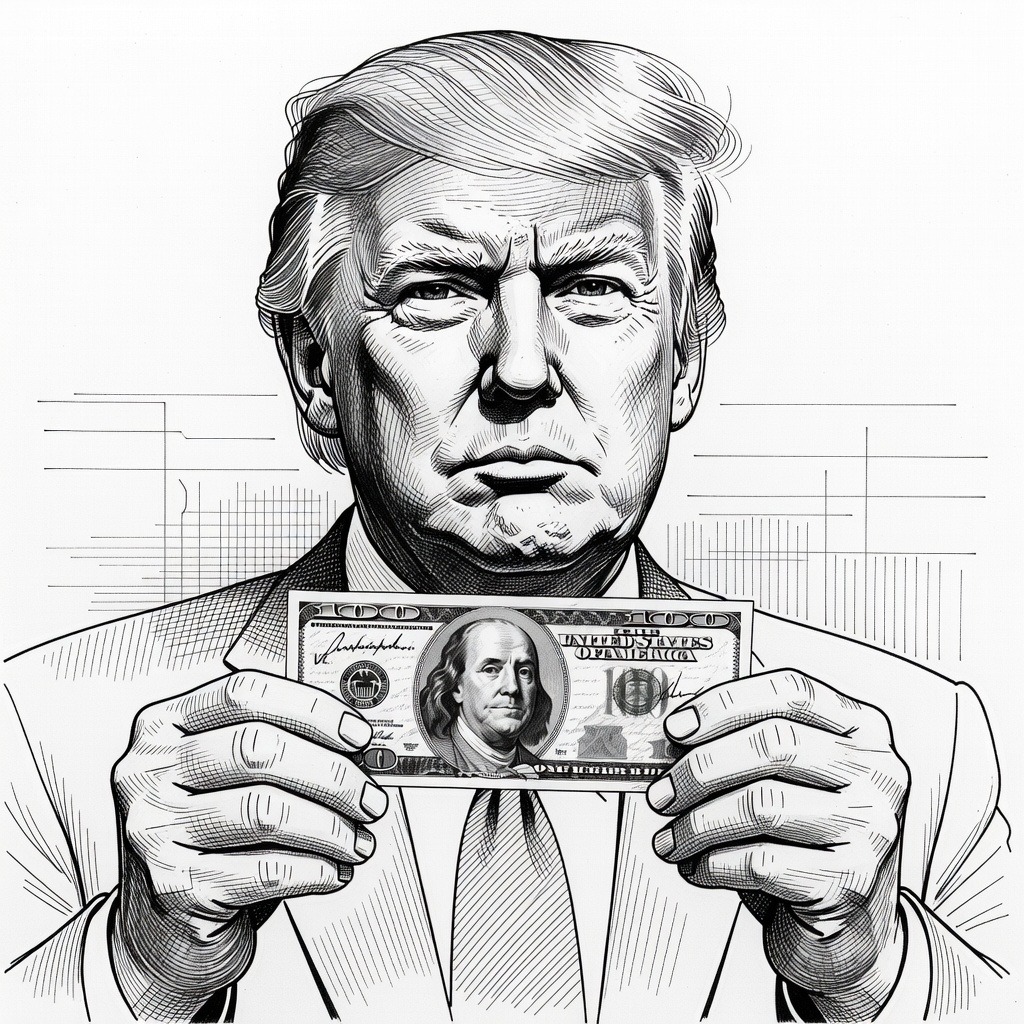
AI-generated illustration. Visual interpretation does not represent real individuals or scenes.
U.S. Treasury to Add President Trump's Signature to Paper Currency
2026-03-27
The BareStory
The United States Treasury Department announced plans to add President Donald Trump's signature to new U.S. paper currency. The update makes him the first sitting president in American history to have his signature printed on the nation's paper money.
According to the Treasury Department, the alteration is intended to commemorate the 250th anniversary of U.S. independence this year. Traditionally, American paper currency has exclusively carried the signatures of Treasury officials. The department stated that the president's signature will be featured alongside that of Treasury Secretary Scott Bessent on updated bills rolling out later this year.
Treasury officials issued statements supporting the decision. Secretary Bessent stated that placing the president's name on the bills recognizes the historic achievements of both the country and the president. Meanwhile, U.S. Treasurer Brandon Beach characterized the unprecedented addition as an appropriate and well-deserved measure.
The currency update follows other federal initiatives marking the nation's upcoming 250th birthday, including the recent approval of a 24-karat gold commemorative coin bearing the president's likeness. It also aligns with broader administration efforts to attach the president's name to national institutions, such as the recent additions of his name to the Kennedy Center and the United States Institute of Peace building.
Left Perspective
Shielding Apolitical State Institutions
Resisting Executive Brand Creep
Protecting Collective Civic Milestones
Right Perspective
Projecting Sovereign Executive Authority
Bolstering Generational Civic Pride
Cementing Legacies of Excellence
Left Perspective
• Shielding Apolitical State Institutions
Prioritizing government accountability requires strict separation between the structural machinery of the state and the personal identity of its leader. Breaking the tradition of exclusively featuring apolitical Treasury officials to include a sitting president's signature fundamentally erodes this necessary boundary. This faction views the unprecedented currency alteration not as a celebration, but as an inappropriate conflation of public fiscal instruments with individual political power.
• Resisting Executive Brand Creep
The systematic effort to attach the president's name to the Kennedy Center and the United States Institute of Peace signals a troubling shift toward personality-driven governance. Secretary Scott Bessent’s assertion that the signature recognizes the president’s "historic achievements" reinforces fears that taxpayer-funded institutions are being co-opted for private political branding. Reformers argue this mirrors autocratic statecraft, deliberately eroding the democratic principle that leaders temporarily serve institutions rather than permanently subsume them.
• Protecting Collective Civic Milestones
Transforming the 250th anniversary of U.S. independence into a mechanism for personal elevation threatens to fracture a unifying national event. Issuing a 24-karat gold commemorative coin bearing the president's likeness alongside the newly signed bills turns a shared historical milestone into a partisan vanity project. The long-term risk perceived by this camp is the permanent degradation of national celebrations, replacing a collective civic inheritance with immediate political self-aggrandizement.
Right Perspective
• Projecting Sovereign Executive Authority
Emphasizing national sovereignty relies on clear, visible assertions of strong leadership at the helm of the state. Integrating the president's signature alongside Treasury Secretary Scott Bessent directly connects the democratically elected chief executive to the nation’s fundamental fiscal instruments. Traditionalists view this unprecedented update as a robust demonstration of accountability, signaling that the administration takes direct ownership of the country's economic foundation.
• Bolstering Generational Civic Pride
Leveraging the 250th anniversary of U.S. independence to introduce updated currency and a 24-karat gold commemorative coin actively nurtures national identity. U.S. Treasurer Brandon Beach’s characterization of the measure as "appropriate and well-deserved" reflects a commitment to institutionalizing patriotism during a rare historical milestone. By embedding the current leadership into this generational event, this camp seeks to create tangible historical touchstones that project national confidence and endurance.
• Cementing Legacies of Excellence
Aligning public spaces with successful leadership reinforces civic duty and respect for established executive accomplishments. The broader administration efforts to attach the president's name to the Kennedy Center and the United States Institute of Peace serve to physically enshrine the era's historic achievements within the national architecture. Traditionalists embrace these rebrandings as a legitimate projection of strength, ensuring that the legacy of a uniquely consequential presidency is permanently woven into the fabric of American institutions.
How it may affect me
As a U.S. reader:
• In the short term, you will begin seeing newly issued paper bills rolling out later this year that feature the sitting president's signature alongside the Treasury Secretary's signature.
• You may encounter or have the opportunity to acquire a newly approved 24-karat gold commemorative coin bearing the president's likeness as part of the 250th anniversary celebrations.
• If you visit or interact with the Kennedy Center or the United States Institute of Peace, you will see the president's name attached to the physical branding of these national buildings.
• In the long term, you will experience a shift in how federal fiscal instruments and shared civic milestones are presented, as traditionally apolitical public symbols are updated to directly incorporate the identity of the executive leadership.