
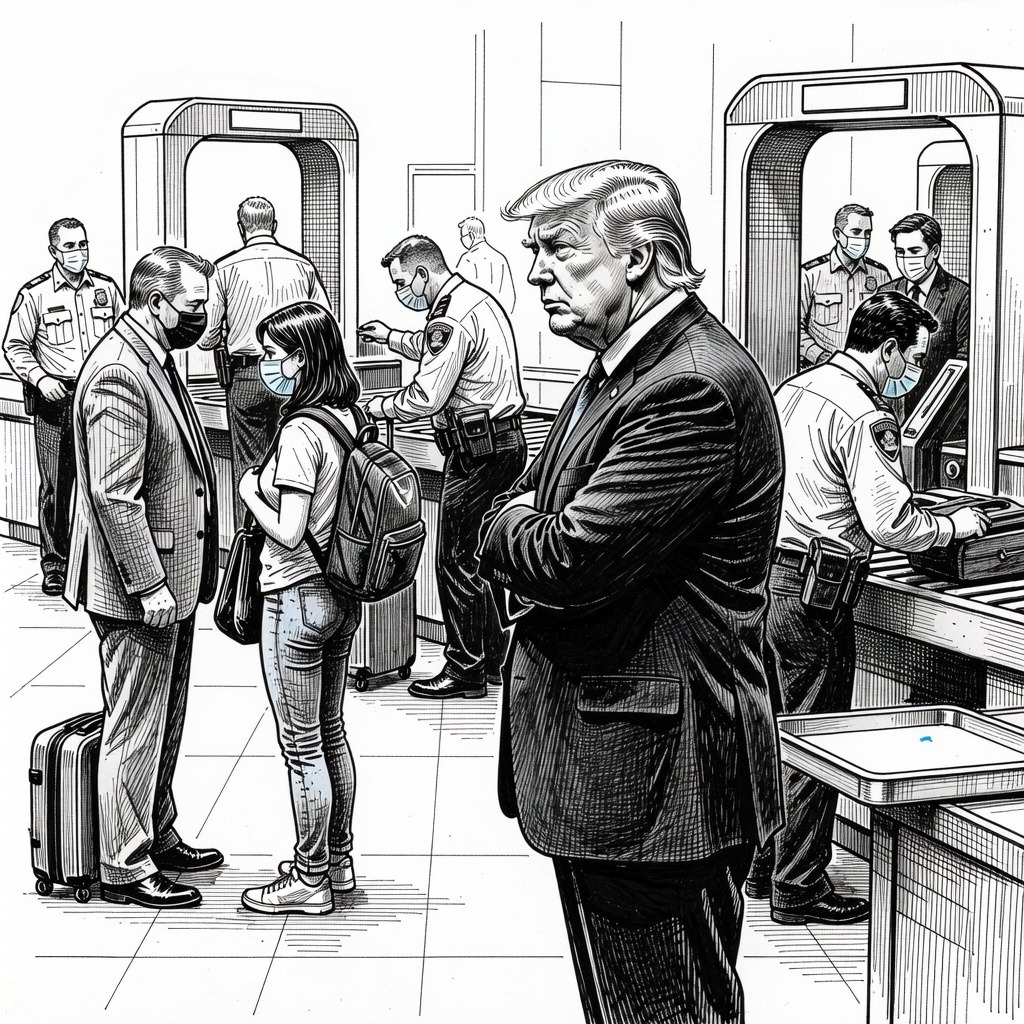
AI-generated illustration. Visual interpretation does not represent real individuals or scenes.
ICE Agents Deployed to US Airports to Assist With Security Lines Amid Government Shutdown
2026-03-23
The BareStory
Immigration and Customs Enforcement (ICE) agents were deployed to several U.S. airports on Monday, including locations in Atlanta and New York City, to assist with hours-long security lines. The deployment follows severe delays caused by a partial government shutdown that has halted Department of Homeland Security funding and left Transportation Security Administration (TSA) officers without paychecks.
President Donald Trump stated that the deployment was his idea, adding that he would consider bringing in the National Guard if additional assistance is necessary. Trump also requested that ICE agents operate without masks while assisting travelers at airports, though he stated he supports mask usage when agents are dealing with suspected criminals. White House border czar Tom Homan said the agents are primarily there to help travelers navigate security, but noted they would respond to any observed criminal activity. Both Trump and Homan attributed the current funding and airport issues to Democratic lawmakers.
The decision has drawn pushback from labor leaders, industry groups, and politicians. Everett Kelly, president of the American Federation of Government Employees, argued that security personnel should be paid rather than replaced by armed agents who lack specialized screening training. Democratic lawmakers also opposed the deployment, with critics asserting that immigration enforcement demands are the root cause of the shutdown. Additionally, the U.S. Travel Association issued a statement criticizing Congress for failing to fund the department and urged lawmakers to resolve the shutdown and pay TSA officers before taking a scheduled recess.
Left Perspective
Defend the Civil Workforce
Resist Domestic Militarization Creep
Reject Manufactured Executive Crises
Right Perspective
Preserve Essential Operational Continuity
Maximize Law Enforcement Utility
Bypass Legislative Gridlock Tactics
Left Perspective
• Defend the Civil Workforce
Prioritizes fair compensation and established labor rights over ad-hoc security patches. Replacing unpaid TSA personnel with armed ICE agents is viewed as an anti-labor tactic that normalizes expecting critical work without reliable pay. Echoing the American Federation of Government Employees, this camp sees bypassing trained screeners as a fundamental devaluation of the civil service ecosystem that leaves workers economically vulnerable.
• Resist Domestic Militarization Creep
Prioritizes civil liberties and civilian-led administration over the expansion of general enforcement powers. Deploying armed ICE personnel—and threatening to use the National Guard—introduces an unnecessary, intimidating law-enforcement posture into routine civilian travel. Relying on agents who lack specific TSA screening training creates a severe risk of operational escalation and compromises the precise, regulatory nature of airport security.
• Reject Manufactured Executive Crises
Prioritizes legislative accountability and views the shutdown as a politically engineered emergency. Democratic lawmakers assert that the administration's own hardline immigration enforcement demands triggered the Department of Homeland Security funding halt in the first place. Repurposing ICE to patch TSA lines is interpreted as a superficial maneuver to mask executive governance failures, deflecting blame onto political opponents while leaving the root legislative dysfunction unresolved.
Right Perspective
• Preserve Essential Operational Continuity
Prioritizes civic order and the immediate functioning of critical national infrastructure over bureaucratic rigidity. The hours-long airport security lines in hubs like Atlanta and New York City represent an unacceptable breakdown in systemic stability. Deploying ICE agents serves as a necessary, pragmatic triage to restore operational flow for citizens, proving that executive agility can maintain vital public services during a funding impasse.
• Maximize Law Enforcement Utility
Prioritizes broad public safety and multi-purpose institutional authority. While Tom Homan notes ICE is primarily there to assist with lines, their inherent capacity to respond to criminal activity provides a crucial secondary layer of domestic security. The presidential directive for agents to operate unmasked fosters approachability for everyday travelers, while their underlying authority naturally deters potential threats during a period of institutional vulnerability.
• Bypass Legislative Gridlock Tactics
Prioritizes decisive executive action in the face of parliamentary dysfunction. By keeping airports functional through ICE deployments and preparing National Guard contingencies, the administration bypasses what it views as partisan obstruction by Democratic lawmakers. This perspective aligns with the U.S. Travel Association's frustration, viewing the executive branch as responsibly managing the crisis while Congress fails its fundamental funding duties ahead of a scheduled recess.
How it may affect me
As a U.S. reader:
• In the short term, travelers flying out of major airports like Atlanta and New York City will encounter unmasked, armed ICE agents, and potentially the National Guard, stationed at civilian security checkpoints.
• Immediate security line wait times and crowd management may shift as these agents are deployed to assist with the hours-long delays caused by the partial government shutdown.
• The routine screening process may carry operational variations or risks, as the deployed ICE personnel lack specialized TSA screening training.
• Passengers may observe an added layer of general law enforcement at airports, as ICE agents are authorized to respond to any suspected criminal activity they witness while managing lines.
• Long-term travel conditions and airport staffing remain vulnerable to disruptions until the legislative funding impasse is resolved and regular TSA personnel resume receiving pay.