
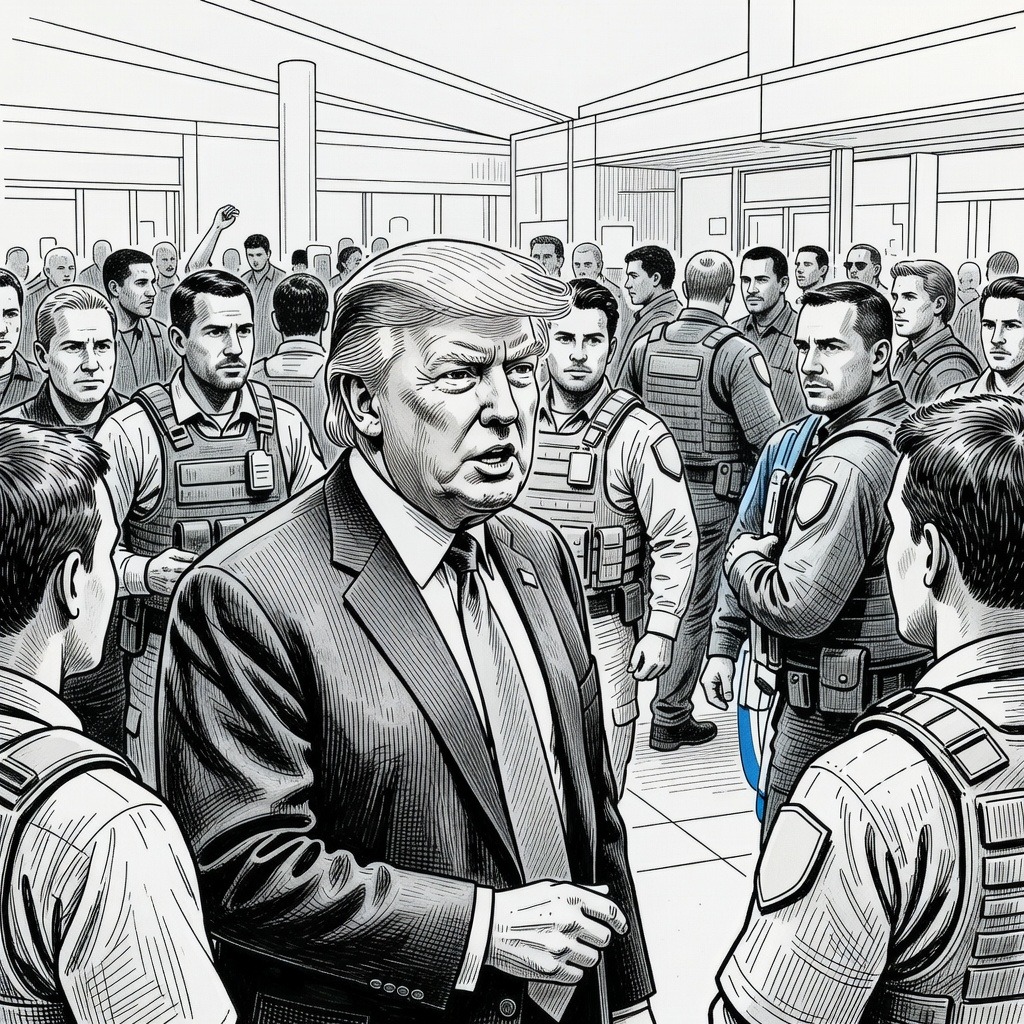
AI-generated illustration. Visual interpretation does not represent real individuals or scenes.
DHS Shutdown Causes Extensive Airport Delays as Trump Threatens to Deploy ICE Agents
2026-03-21
The BareStory
A partial government funding lapse for the Department of Homeland Security is nearing its fifth week, forcing Transportation Security Administration (TSA) employees to work without pay. The standoff has resulted in over 300 resignations, rising absenteeism, and severe staffing shortages across the agency. Travelers at major hubs, including airports in Atlanta, Houston, and New Orleans, are experiencing widespread congestion, with security wait times extending well over two hours.
On Saturday, President Donald Trump announced that he will deploy Immigration and Customs Enforcement (ICE) agents to airports to conduct security operations and arrest undocumented immigrants if the impasse continues. Trump stated the deployment would specifically target Somalian immigrants, claiming they have destroyed Minnesota with the approval of local and federal politicians.
The legislative stalemate centers on Democratic demands for changes to immigration enforcement protocols, such as requiring warrants for home entries and banning masks for agents. Democratic lawmakers attribute their demands to recent incidents in Minneapolis, alleging that federal immigration agents were responsible for civilian deaths during recent operational surges. In response to the standstill, Senate Democrats proposed funding the TSA independently while immigration negotiations continue.
As unpaid federal personnel experience mounting financial hardship, billionaire Elon Musk offered on Saturday to fund the salaries of TSA workers. Meanwhile, at least 20 airports utilizing the TSA's Screening Partnership Program—which relies on private contractors paid through pre-approved federal contracts—have successfully avoided disruptions and maintained normal security operations.
Left Perspective
Curbing Authoritarian State Overreach
Mandating State Force Accountability
Shielding Essential Public Infrastructure
Right Perspective
Preserving Sovereign Security Imperatives
Defending Law Enforcement Efficacy
Validating Private Sector Resilience
Left Perspective
• Curbing Authoritarian State Overreach
Targeting specific communities—like Somalian immigrants in Minnesota—and utilizing ICE for domestic airport operations violates fundamental equal protection norms. The executive branch's threat to weaponize an immigration enforcement agency to police civilian travel hubs is viewed as an abuse of state power. This framework perceives the five-week shutdown not just as a funding lapse, but as a manufactured pressure campaign designed to legitimize discriminatory, unchecked policing tactics.
• Mandating State Force Accountability
The legislative demands to require home-entry warrants and ban masks for federal agents are strictly anchored in civil liberties and preserving constitutional due process. Following alleged civilian deaths tied to federal immigration surges in Minneapolis, agent anonymity and warrantless entries are viewed as catalysts for unaccountable state violence. Structural reform of ICE protocols is treated as a non-negotiable moral necessity to protect vulnerable populations from institutional harm.
• Shielding Essential Public Infrastructure
Leaving TSA workers unpaid to the point of forcing over 300 resignations constitutes a severe abdication of institutional governance and worker protection. The proposal to fund the TSA independently is a strategic maneuver to uncouple essential public safety personnel from polarized ideological fights. Relying on billionaire philanthropists like Elon Musk to subsidize federal wages signals a dangerous degradation of state capacity and the government's basic duty to its workforce.
Right Perspective
• Preserving Sovereign Security Imperatives
Deploying ICE agents to major hubs ensures that critical national security apparatuses remain functional during a severe bureaucratic funding lapse. The executive mandate prioritizes enforcing existing immigration laws and maintaining operational control over vulnerable civilian travel hubs, regardless of legislative gridlock. Addressing the direct impact of undocumented populations on specific local jurisdictions, such as Minnesota, is viewed as a necessary defense of community order and sovereign borders.
• Defending Law Enforcement Efficacy
Restricting federal agents through mandatory home warrants and mask bans fundamentally degrades their tactical safety and operational effectiveness. Stripping anonymity from agents during high-risk enforcement surges exposes law enforcement personnel to targeted retaliation and unnecessary physical danger. This camp interprets the legislative demands as a direct attempt to hamstring the very institutions tasked with upholding the rule of law and maintaining domestic stability.
• Validating Private Sector Resilience
The uninterrupted security operations at the 20 airports utilizing the Screening Partnership Program demonstrate the inherent stability of privatized, decentralized frameworks. While federal bureaucracies suffer massive absenteeism and crippling two-hour delays in Atlanta, Houston, and New Orleans, pre-approved private contractors maintain seamless civic continuity. Elon Musk's offer to fund salaries further reinforces the underlying philosophy that private capital and market-based solutions are highly agile mechanisms for crisis management.
How it may affect me
As a U.S. reader:
• In the short term, individuals flying through major government-operated airports, such as those in Atlanta, Houston, and New Orleans, will encounter severe congestion and security wait times exceeding two hours due to ongoing TSA staffing shortages and resignations.
• Travelers may soon see ICE agents conducting domestic security and immigration operations at airports, potentially resulting in localized arrests that specifically target undocumented individuals and Somalian immigrants.
• Passengers utilizing the 20 airports operating under the privatized Screening Partnership Program will likely experience normal, uninterrupted security processing without the delays affecting federalized travel hubs.
• In the long term, civilians could see altered interactions with federal law enforcement, as ongoing legislative negotiations may mandate home-entry warrants and prohibit agents from wearing masks during immigration enforcement surges.
• The immediate stability of airport security operations will depend on whether unpaid federal workers continue to resign or if temporary private interventions, such as Elon Musk's offer to subsidize TSA salaries, are implemented to maintain staffing.