
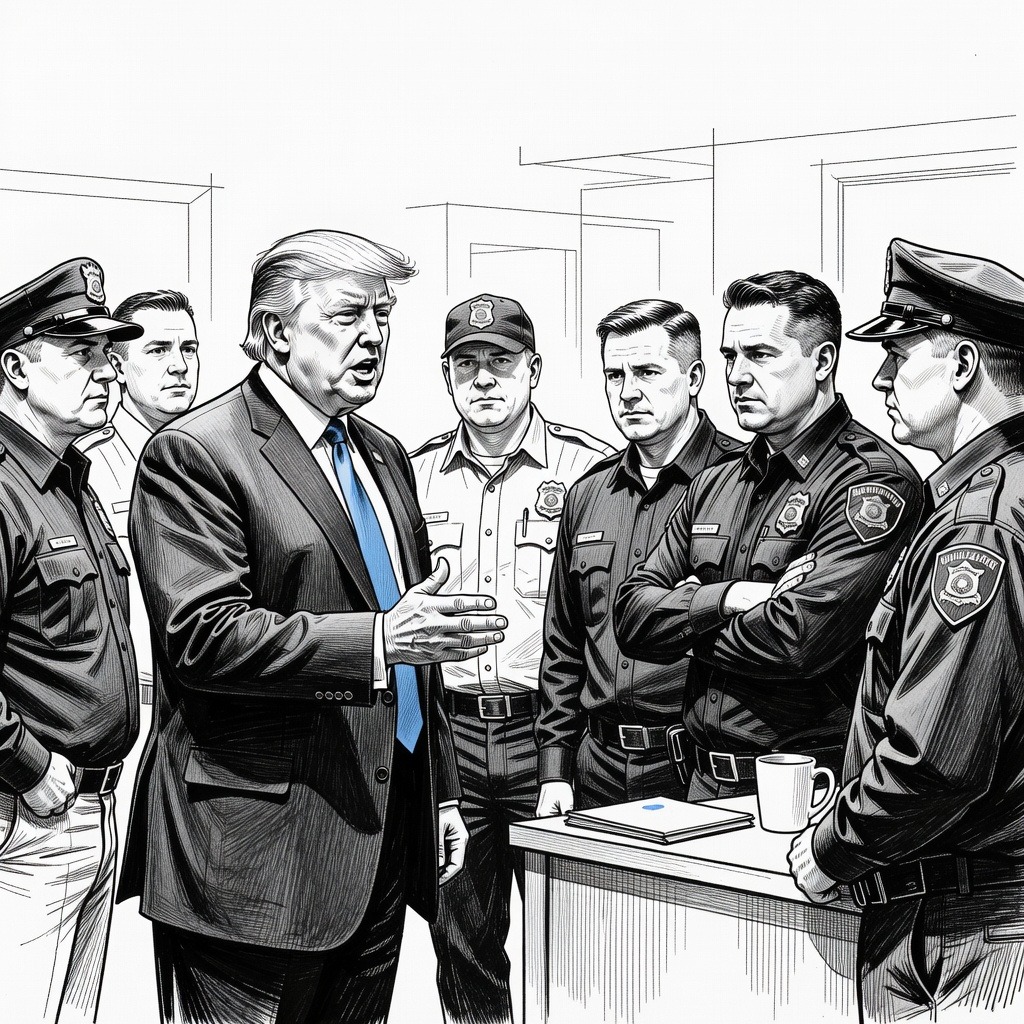
AI-generated illustration. Visual interpretation does not represent real individuals or scenes.
Government Shutdown Reaches One-Month Mark Amid Legislative Standoff Over Homeland Security Funding
2026-03-14
The BareStory
A partial government shutdown affecting the Department of Homeland Security has reached the one-month mark, leaving agencies such as the Transportation Security Administration, the Coast Guard, and the Federal Emergency Management Agency without current funding. The lapse, which began on February 14, centers on a legislative dispute over Immigration and Customs Enforcement. Democratic lawmakers are demanding specific operational reforms for immigration agencies before funding the broader department, while Republicans reject the conditions.
Approximately 50,000 transportation security officers are working without compensation and recently missed an expected paycheck. The funding lapse has led to over 300 resignations within the agency and a doubling of unscheduled absences, resulting in checkpoint closures and extended security lines at multiple airports. President Donald Trump thanked the agents working without pay and attributed the shutdown to the "radical left." Authorities also report localized frustrations at airports; federal prosecutors charged a man with assaulting a federal officer after he allegedly attacked security and police personnel during an identity check at a Dallas airport.
Senate Republicans, who hold 53 seats and require 60 votes to advance funding legislation, argue the shutdown compromises national security amid rising domestic terrorist threats. Following a recent fatal shooting at Old Dominion University, which the FBI is investigating as an act of terrorism, Republicans maintain that full funding for the department is necessary.
Conversely, Democratic senators insist their requested immigration reforms—which include stricter warrant requirements and a ban on agent masks—are necessary safeguards following the deaths of two civilians during encounters with immigration enforcement in Minnesota. Democrats state they are willing to fund non-immigration agencies through standalone bills, but claim that Republicans have blocked those efforts.
Left Perspective
Demand Strict Institutional Accountability
Target Rogue Agency Operations
Expose Frontline Labor Exploitation
Right Perspective
Preserve Unified Security Readiness
Reject Ideological Hostage Tactics
Defend Essential Operational Authority
Left Perspective
• Demand Strict Institutional Accountability
Civil liberties and human rights protections must supersede unconditional agency funding. The deaths of two civilians during immigration enforcement encounters in Minnesota demonstrate a fatal lack of oversight within the system. Leveraging the broader Homeland Security budget is viewed as the only viable mechanism to force structural changes—such as stricter warrant requirements and bans on agent masks—reining in a federal police force that reformers believe operates with dangerous impunity.
• Target Rogue Agency Operations
Essential government services should not be used as shields to protect a single, controversial department from reform. By offering standalone funding bills for the TSA, Coast Guard, and FEMA, reformers attempt to surgically bypass the legislative standoff. This tactical compartmentalization isolates Immigration and Customs Enforcement, framing the Republican blockade of these piecemeal bills as a deliberate choice to manufacture a wider crisis rather than negotiate targeted operational reforms.
• Expose Frontline Labor Exploitation
Relying on 50,000 transportation security officers to secure airports without compensation represents a severe systemic failure and a violation of the social contract. The resulting 300 resignations and doubled unscheduled absences are interpreted as the inevitable breakdown of an exploitative labor dynamic. To this camp, presidential praise for unpaid agents merely masks underlying institutional abuse, unfairly transferring the punitive cost of political gridlock directly onto working-class civil servants.
Right Perspective
• Preserve Unified Security Readiness
National sovereignty and domestic stability require an uncompromised, fully funded defense apparatus. With the FBI actively investigating a fatal shooting at Old Dominion University as an act of terrorism, traditionalists view the deliberate defunding of the Department of Homeland Security as a direct threat to public safety. Maintaining the institutional continuity of this vital security umbrella is an absolute civic duty that must never be subordinated to partisan negotiations.
• Reject Ideological Hostage Tactics
Core state functions must be strictly insulated from activist coercion. Senate Republicans, holding 53 seats and facing a 60-vote threshold to advance funding, view the operational demands imposed on immigration agencies as a form of legislative extortion. Acquiescing to conditional funding validates the strategy of using essential national security infrastructure as a weapon, setting a destabilizing precedent that threatens the rule of law in future legislative cycles.
• Defend Essential Operational Authority
Frontline law enforcement requires steadfast institutional backing and tactical flexibility to execute its mandate safely. The traditionalist framework interprets the push for stricter warrants and mask bans not as accountability, but as an active erosion of federal authority that deliberately endangers officers. The violent assault on a federal officer during an identity check at a Dallas airport underscores the inherently volatile environment these agents navigate, reinforcing the imperative to support the security apparatus rather than politically handicap its operators.
How it may affect me
As a U.S. reader:
• In the short term, air travelers will likely face extended security wait times, checkpoint closures, and increasingly volatile environments at airports due to growing resignations and unscheduled absences among unpaid transportation security officers.
• Immediate public safety and emergency response capabilities could be compromised, as the Federal Emergency Management Agency and the Coast Guard are currently operating without updated funding.
• Broader national security operations may experience short-term disruptions, potentially affecting active domestic terrorism investigations such as the FBI response to a recent fatal university shooting.
• In the long term, if a legislative compromise is reached, the public may see operational changes to federal immigration enforcement, which could include the implementation of stricter warrant requirements and bans on masks for agents during civilian encounters.
• Funding for non-immigration agencies like the Transportation Security Administration and the Coast Guard could eventually be separated from border enforcement budgets if lawmakers agree to pass proposed standalone funding bills.