
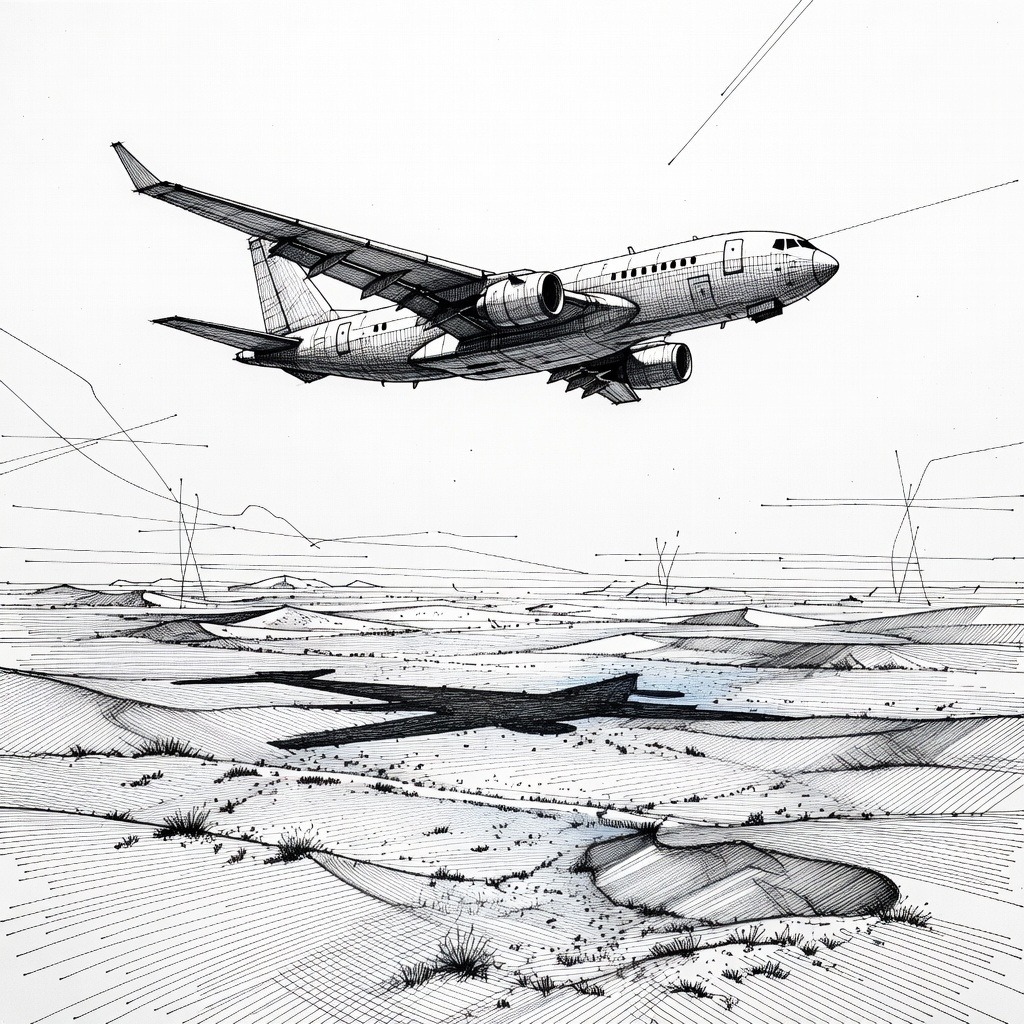
AI-generated illustration. Visual interpretation does not represent real individuals or scenes.
Four U.S. Service Members Killed in Refueling Aircraft Crash in Western Iraq
2026-03-13
The BareStory
Four United States service members were killed Thursday when a KC-135 aerial refueling aircraft crashed in western Iraq. The aircraft, carrying a crew of six, went down near the town of Turaibil along the Jordanian border while participating in ongoing regional military operations.
U.S. Central Command stated the crash occurred in friendly airspace and was not caused by hostile or friendly fire. Military officials indicated the event involved a mid-air incident with a second KC-135 tanker. The second aircraft sustained damage but managed to safely make an emergency landing. Despite the military's assessment that enemy fire was not involved, an Iran-backed militia group known as the Islamic Resistance in Iraq released a statement claiming responsibility for downing the plane.
Active search and rescue operations are underway to locate the two unaccounted-for crew members from the downed tanker. Defense officials stated that the identities of the deceased personnel will be withheld until 24 hours after their families have been notified, while military teams work to secure the crash site and recover sensitive equipment.
The incident marks the fourth publicly acknowledged loss of a U.S. military aircraft since the start of the current conflict with Iran, which began on February 28. The crash occurred as United States and Israeli forces continue to conduct widespread military operations and strikes across the region.
Left Perspective
Measuring the Fatal Entanglement
Fueling Adversarial Propaganda Pipelines
Exposing Severe Operational Overextension
Right Perspective
Sustaining Critical Power Projection
Neutralizing Militia Disinformation Narratives
Absorbing the Friction of Deterrence
Left Perspective
• Measuring the Fatal Entanglement
Prioritizes human life over perpetual foreign deployment. The loss of four service members and two unaccounted for highlights the devastating, tangible toll of maintaining a sprawling military posture in the Middle East. Even without direct enemy engagement, the extreme operational tempo required to support widespread U.S. and Israeli regional strikes creates inherently fatal conditions for personnel operating these aerial lifelines.
• Fueling Adversarial Propaganda Pipelines
Prioritizes de-escalation and questions the utility of endless regional proximity. The false claim of responsibility by the Iran-backed Islamic Resistance in Iraq illustrates how a massive U.S. footprint actively feeds adversarial narratives. By maintaining vulnerable logistical operations near the Jordanian border, the military inadvertently supplies hostile militias with the localized friction needed to inflate their relevance, recruit fighters, and escalate regional tensions.
• Exposing Severe Operational Overextension
Prioritizes systemic stability over endless kinetic action. The loss of four U.S. military aircraft since the conflict with Iran escalated on February 28 is interpreted as a glaring indicator of severe operational fatigue. This camp views the continuous mid-air refueling necessary to enable widespread strikes as an unsustainable strategy that inevitably degrades equipment and exhausts crews, signaling a critical need for diplomatic resolution rather than further military stretching.
Right Perspective
• Sustaining Critical Power Projection
Prioritizes operational continuity and the projection of strength. The deployment of KC-135 tankers over western Iraq represents the indispensable logistical backbone required to keep U.S. and Israeli forces active across a massive, hostile theater. The immediate mission to secure the crash site and recover sensitive equipment underscores the absolute necessity of maintaining forward presence and protecting the complex assets that make regional deterrence possible.
• Neutralizing Militia Disinformation Narratives
Prioritizes strategic clarity and institutional credibility. CENTCOM’s definitive assessment that the crash involved a mid-air incident with a second U.S. aircraft—rather than hostile fire—actively strips unearned tactical victories from adversarial proxy groups. By immediately invalidating the Islamic Resistance in Iraq’s claim of responsibility, military leadership effectively crushes hostile disinformation and denies enemy forces the psychological leverage of projecting false strength.
• Absorbing the Friction of Deterrence
Prioritizes national security objectives despite the inherent costs of complex combat environments. Losing four aircraft since hostilities with Iran began on February 28 represents the grim, unavoidable friction of executing high-stakes military deterrence. This framework accepts that conducting widespread strikes alongside allies demands a punishing operational tempo, viewing these tragic logistical casualties as the painful but necessary price of enforcing stability through strength.
How it may affect me
As a U.S. reader:
• In the short term, military communities and families will be directly affected by these casualties as the Defense Department completes its 24-hour notification process for the four deceased and two unaccounted-for service members.
• Citizens following the conflict will need to navigate conflicting information, as official military reports of non-hostile mid-air incidents compete with adversarial disinformation and propaganda from foreign militias claiming responsibility for U.S. losses.
• In the long term, the public may experience the material and financial impacts of operational overextension, as the loss of four military aircraft since late February indicates a steady degradation of high-value equipment that requires sustained national resources to replace and maintain.
• As U.S. and Israeli regional operations continue, voters and taxpayers will likely face ongoing domestic policy debates regarding whether the high-tempo costs of enforcing military deterrence are necessary or if the situation demands diplomatic de-escalation.