
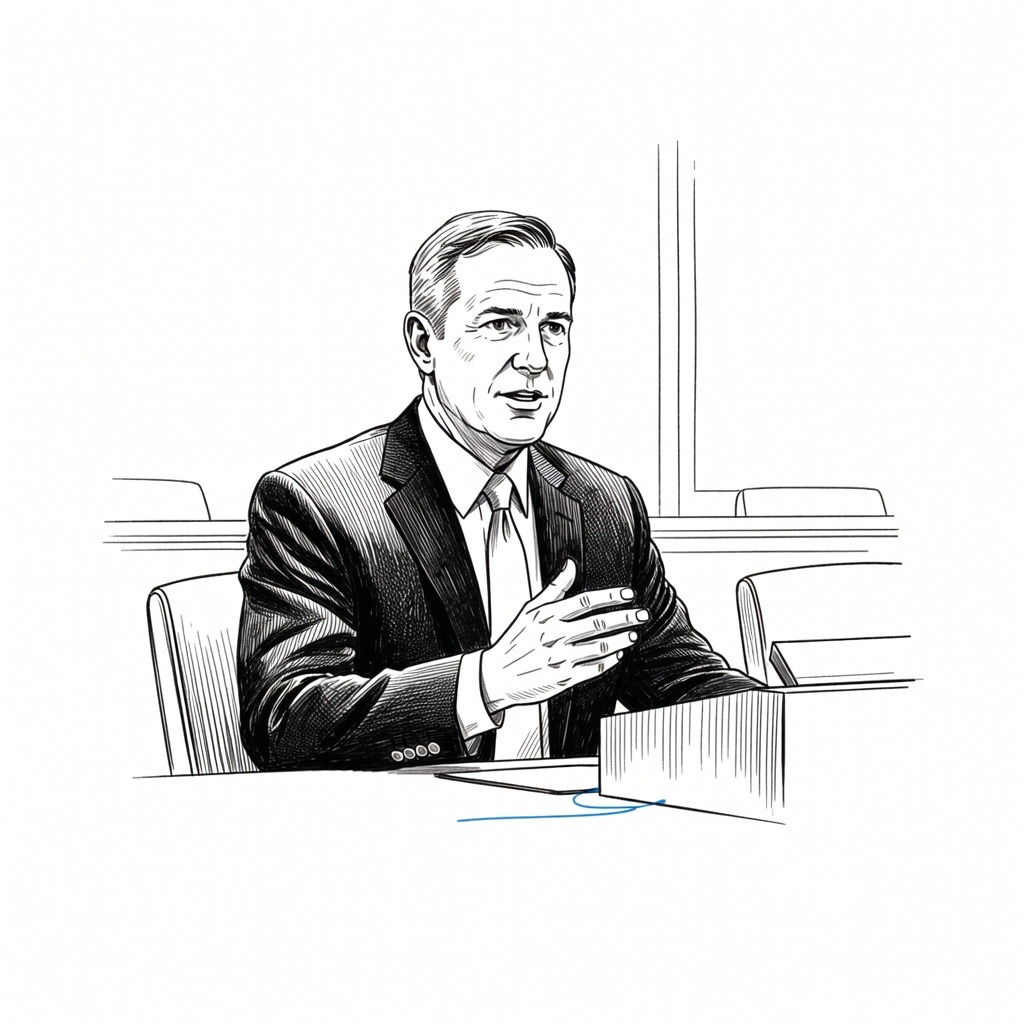
AI-generated illustration. Visual interpretation does not represent real individuals or scenes.
House Oversight Committee Seeks Additional Testimonies in Epstein Investigation
2026-03-11
The BareStory
House Oversight Committee Chairman James Comer announced on Wednesday that lawmakers are seeking testimony from a former prison guard and two cabinet officials as part of a continuing congressional investigation into the Jeffrey Epstein case.
According to Comer, the committee requested a transcribed interview with Tova Noel, a guard on duty the night Epstein died in jail. The chairman cited Department of Justice documents alleging Noel made a $5,000 cash deposit days before the death and searched online for updates regarding Epstein on the day he died—an action Comer stated she previously denied in a 2021 sworn statement. Comer clarified that Noel is not currently accused of any wrongdoing.
The committee is also working to schedule testimony from Attorney General Pam Bondi and Commerce Secretary Howard Lutnick within the coming weeks. Lawmakers recently voted to subpoena Bondi regarding the Justice Department's management and redaction of Epstein case files. Lutnick, who is not accused of wrongdoing, agreed to cooperate voluntarily to answer questions about his past relationship with Epstein after acknowledging a previous meeting with the financier.
Comer stated on Wednesday that he was also preparing to attend a deposition with Richard Kahn, a former accountant for Epstein. These ongoing inquiries follow a closed-door deposition held on February 9 with Epstein associate Ghislaine Maxwell.
Left Perspective
Dismantling Elite Impunity
Forcing Bureaucratic Transparency
Exposing Systemic Vulnerabilities
Right Perspective
Rooting Out Operational Corruption
Piercing the Administrative Shield
Purging Shadow Networks
Left Perspective
• Dismantling Elite Impunity
Social equity demands that vast wealth cannot purchase immunity from the justice system. By preparing depositions for Epstein’s former accountant Richard Kahn and securing cooperation from Commerce Secretary Howard Lutnick about his past relationship with the financier, this framework views the investigation as a critical strike against the financial scaffolding of the ultra-rich. The core priority is exposing how elite social and economic networks insulate powerful actors from structural accountability.
• Forcing Bureaucratic Transparency
Institutional secrecy inherently favors the privileged and prevents comprehensive structural reform. The committee’s decision to subpoena Attorney General Pam Bondi over the Justice Department's redaction of Epstein case files is valued as a necessary tool to shatter government opacity. This perspective maintains that public trust can only be rebuilt when federal agencies are stripped of their ability to quietly bury the actions and associations of the well-connected.
• Exposing Systemic Vulnerabilities
The failure of the penal system to securely hold a high-profile inmate represents a gross breakdown of state duty to administer equal justice. Analyzing guard Tova Noel’s unexplained $5,000 deposit and internet search history highlights how easily low-level workers might be financially leveraged or compromised. The long-term risk feared here is that without total institutional overhaul, the criminal justice system will remain fundamentally susceptible to capital-driven manipulation and corruption.
Right Perspective
• Rooting Out Operational Corruption
The preservation of social order relies entirely on the absolute integrity of those tasked with enforcing the law. Investigating prison guard Tova Noel over her contradictory 2021 sworn statement and the suspicious $5,000 cash deposit represents a vital effort to identify localized subversion of civic duty. Uncovering whether bribery or conspiracy compromised federal authority is essential to restoring the baseline rule of law within state institutions.
• Piercing the Administrative Shield
Unaccountable bureaucracies pose a direct threat to democratic governance and the continuity of established systems. Subpoenaing Attorney General Pam Bondi to answer for the Justice Department's management and redaction of case files serves as a necessary legislative check against the overreach of the administrative state. This camp prioritizes institutional integrity, demanding that federal law enforcement answers to congressional oversight rather than operating as a self-protecting silo.
• Purging Shadow Networks
Maintaining civic trust requires excising any lingering ties between government officials and criminal enterprises. Securing the voluntary cooperation of cabinet officials like Howard Lutnick and holding closed-door depositions with figures like Ghislaine Maxwell are viewed as tactical necessities to map and eradicate subversive influence. The primary fear is that failing to aggressively untangle these associations leaves the highest levels of government vulnerable to ongoing moral compromise and external leverage.
How it may affect me
As a U.S. reader:
• In the short term, the public may see increased transparency regarding federal investigations as congressional subpoenas attempt to force the Justice Department to disclose previously redacted case files.
• Citizens could witness greater legislative oversight over current government officials, which aims to map out and clarify any past relationships between high-ranking cabinet members and known criminal networks.
• In the long term, inquiries into the unexplained financial activities of federal prison guards may prompt structural reforms within the penal system to prevent low-level workers from being subjected to bribery or financial manipulation.
• Long-term public trust in the criminal justice system may be directly affected by whether these investigative efforts successfully demonstrate that wealthy individuals and federal bureaucracies are held to the same standard of legal accountability as the general population.