
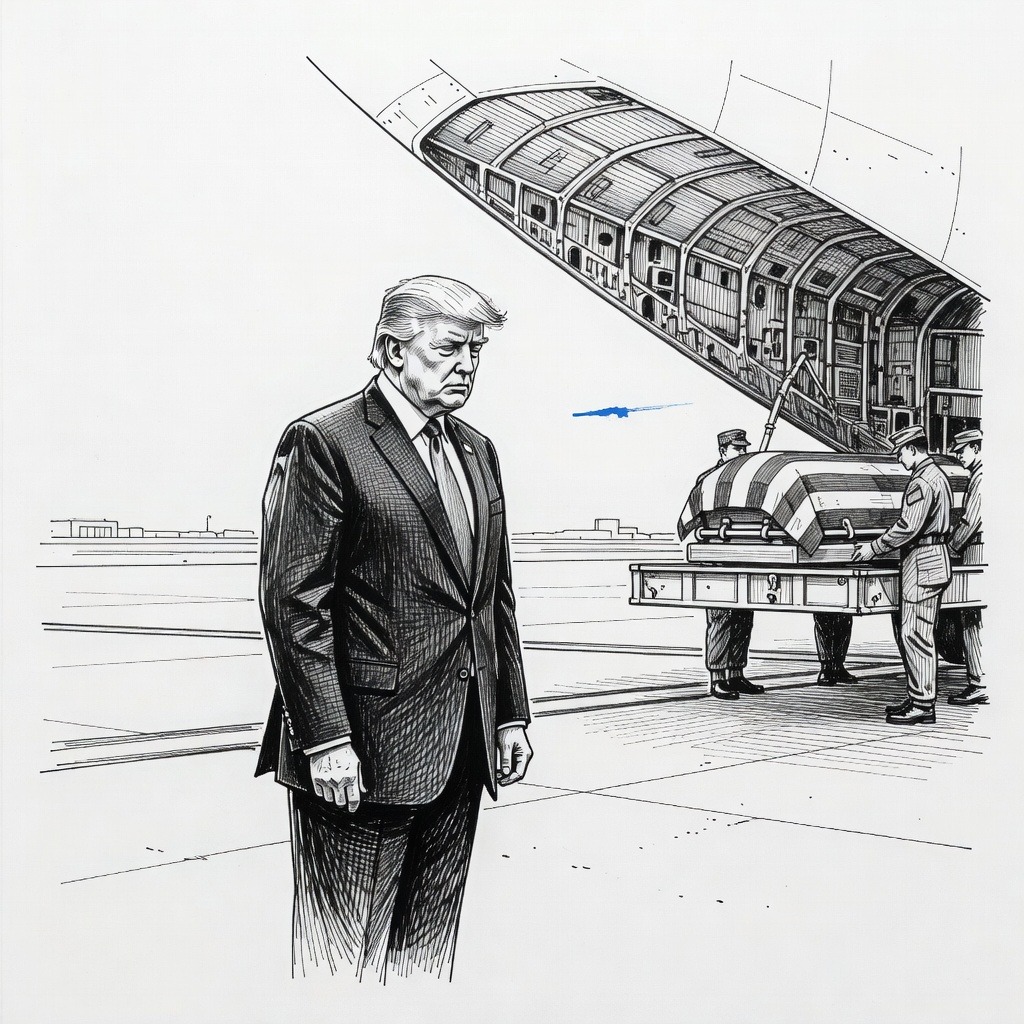
• Consequences of Military Escalation Prioritizing diplomatic de-escalation requires acknowledging the direct human costs of aggressive foreign policy maneuvers. The death of six U.S. soldiers in a Kuwait drone strike is viewed as the tragic, predictable fallout of the recent joint military campaign launched with Israel against Iran. This perspective interprets the loss of life as a failure of deterrence that needlessly endangers service members by provoking retaliatory regional violence. Protecting vulnerable troops demands exhausting all diplomatic avenues before choosing military escalation.
• Exploiting the Military Apparatus Maintaining a strict boundary between military administration and partisan politics is essential for institutional accountability. The scheduled campaign fundraiser featuring Defense Secretary Pete Hegseth during an active military conflict is seen as a severe ethical breach. Accusations from Democrats and the DCCC highlight the danger of leveraging a geopolitical crisis for political gain, framing the eventual postponement by Representative Zach Nunn as a forced retreat rather than a genuine moral choice. Treating warfare as campaign material fundamentally undermines the solemnity of the soldiers' sacrifice.
• Hollow Diplomatic Theater Genuine international cooperation relies on inclusive, established frameworks rather than transactional, exclusionary gatherings. Hosting the Shield of the Americas summit at the president’s private Doral resort to replace the tenth Summit of the Americas is viewed as a degradation of diplomatic norms. The glaring absence of major regional powers like Brazil, Mexico, and Colombia signals a severe fracture in U.S. soft power and hemispheric coalition-building. This approach risks isolating the United States by replacing broad, consensus-driven diplomacy with unilateral posturing.
How it may affect me
As a U.S. reader:
• The recent joint military operations against Iran and the fatal drone strike in Kuwait indicate a heightened short-term risk of retaliatory violence, potentially endangering other U.S. service members stationed in the region.
• Anticipated agreements aimed at regional drug cartels could have long-term impacts on domestic security by directly targeting the transnational trafficking networks that influence crime within U.S. borders.
• The administration's strategic pivot toward the Western Hemisphere, combined with the absence of key nations like Mexico and Brazil at the recent summit, signals a long-term shift in diplomacy that may alter future regional alliances and international cooperation frameworks.