
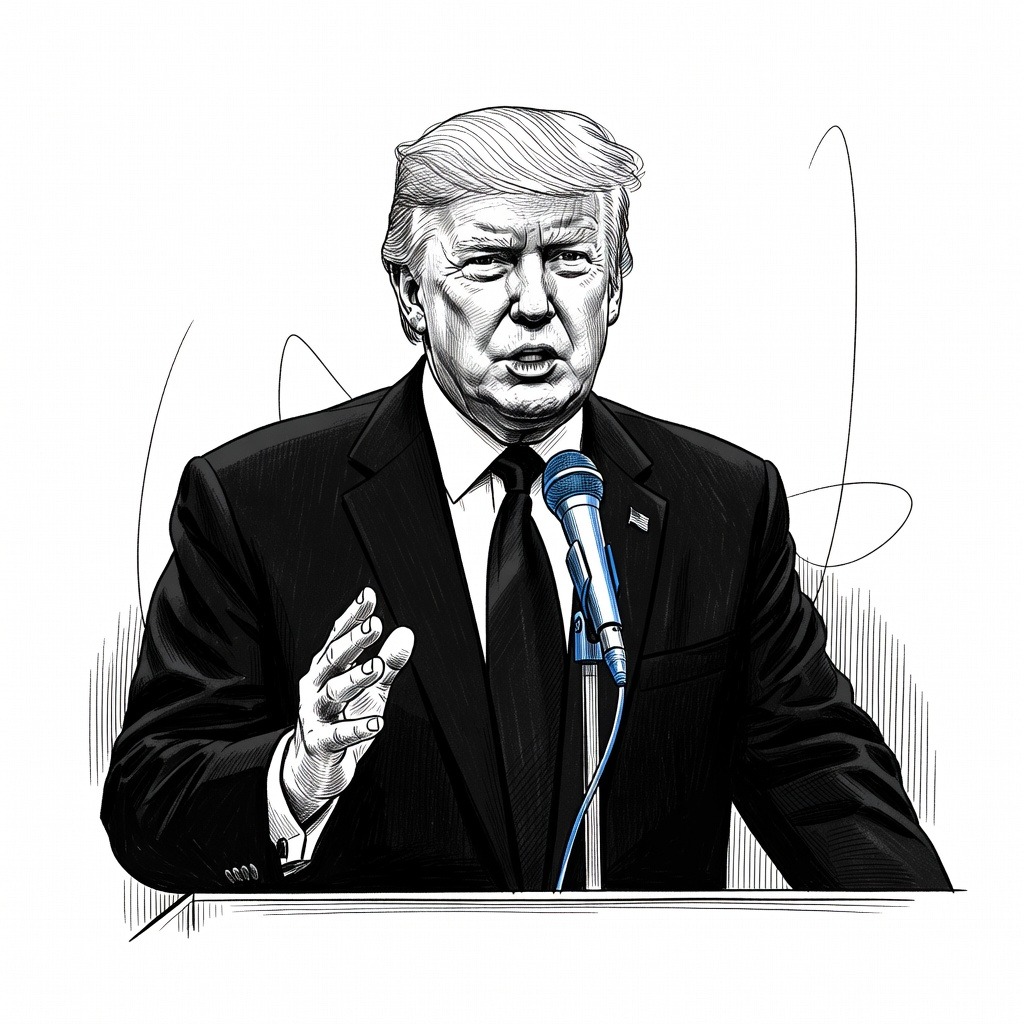
President announces 15% global tariff following Supreme Court defeat

Illustration for: President announces 15% global tariff following Supreme Court defeat
AI-generated illustration. Visual interpretation does not represent real individuals or scenes.

THE BARE STORY

President Donald Trump announced on Saturday that he is raising global tariffs to 15 percent, stating the measure is "effective immediately." The declaration, made via social media, came just one day after the Supreme Court struck down his administration's previous "reciprocal" tariffs. The President had initially proposed a 10 percent global tariff on Friday following the court's ruling, before increasing the rate to 15 percent the following day.

The Supreme Court ruled 6-3 on Friday that the administration wrongfully invoked the International Emergency Economic Powers Act to implement the earlier levies. In response to the decision, the President is now citing Section 122 of the Trade Act of 1974 as the legal basis for the new tariffs. This statute allows the executive branch to implement temporary levies, though extending them requires approval from Congress.

President Trump criticized the Supreme Court's decision as "ridiculous" and "anti-American," specifically singling out two justices who voted with the majority. While the President claimed the new 15 percent rate was immediate, a White House fact sheet released Friday indicated that the originally proposed 10 percent tariffs were scheduled to take effect on Tuesday. It remains unclear if official documentation has been signed to formalize the timing of the higher rate.

The court’s ruling declared the previous tariffs illegal but did not specify whether the government must return collected funds. Estimates suggest companies may seek refunds totaling as much as $175 billion. The President remarked that legal disputes over refunds could take years, while experts noted that the issue would likely be remanded to lower courts. According to official data, the U.S. trade deficit reached $901 billion in 2025.

Same Facts. Different Perspectives.

Two AI models. Two viewpoints. One factual foundation.

• Destabilizing Economic Predictability Prioritizing the stability of market rules, this camp views the immediate pivot to Section 122 of the Trade Act of 1974 as a chaotic reaction to a legal defeat. By swiftly replacing a voided policy with a higher 15 percent rate, the administration undermines the regulatory certainty that businesses require for long-term planning. The logic here is that erratic shifts in trade policy create market volatility that outweighs any potential benefits of protectionism.

• Regressive Wealth Extraction Focusing on social equity, this perspective interprets the 15 percent global tariff as a direct tax on the populace rather than a penalty on foreign powers. Because tariffs are often passed down as higher prices, this framework argues that the measure will disproportionately extract wealth from everyday consumers to subsidize state objectives. The skepticism extends to the administration's dismissal of the Supreme Court's 6-3 ruling, seeing it as an attempt to bypass checks meant to protect the public from executive overreach.

• Fiscal Liability Exposure Concerned with the stewardship of public funds, this side highlights the looming $175 billion in potential refunds as a massive liability created by administrative overstep. The President’s admission that legal disputes could take years is viewed not as a strategy, but as a failure to address the immediate financial damage confirmed by the court’s rejection of the IEEPA justification. The fear is that prolonging these battles only compounds the eventual cost to the taxpayer.

How it may affect me

As a U.S. reader:

• You may face increased costs for everyday goods if businesses pass the expense of the new 15 percent global tariff on to consumers.

• Domestic manufacturing could eventually expand as the administration uses these levies to incentivize local production and address the $901 billion trade deficit.

• You might experience continued economic unpredictability because the new tariffs are temporary under Section 122 of the Trade Act of 1974 and require Congressional approval to remain in place long-term.

• The federal treasury faces a significant financial variable regarding $175 billion in previously collected funds, which could either be refunded to companies or tied up in legal disputes for years.

Read the story at

Note: All TheBareNews content is AI-generated. For additional context, reporting, and updates, you are invited to explore the news outlets linked above.