
House leadership moves to block tariff challenges amid Republican dissent

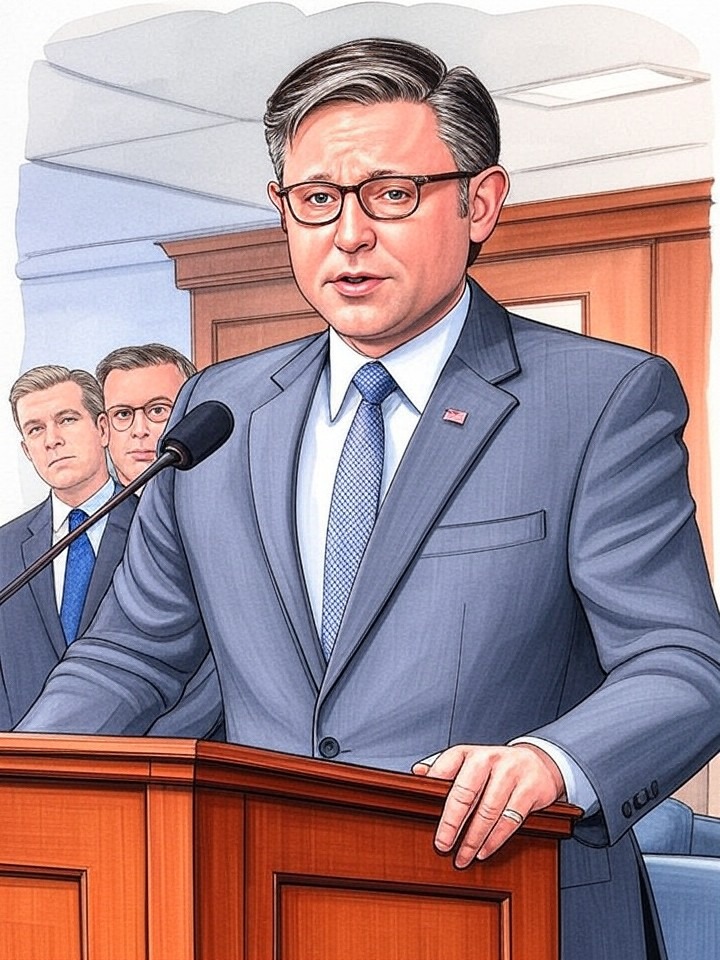
Illustration for: House leadership moves to block tariff challenges amid Republican dissent
AI-generated illustration. Visual interpretation does not represent real individuals or scenes.

THE BARE STORY

House Speaker Mike Johnson confirmed on Tuesday that Republican leadership is proceeding with a procedural vote designed to prevent the House from challenging President Donald Trump’s tariffs until July 31. The provision, which was attached to a rule governing debate on unrelated critical minerals legislation, would block votes on privileged resolutions of disapproval regarding the president's trade policies.

Speaker Johnson argued that the delay is logical to allow the Supreme Court time to issue a ruling on pending legal challenges to the tariffs, a decision expected by late June. The previous House prohibition on such votes expired at the end of January, and Democrats had reportedly planned to force a vote on the issue as early as this week. Johnson also defended the president's trade policies, stating they have been beneficial to the country.

The measure faces uncertainty due to a slim Republican majority and internal opposition. Republican Representatives Thomas Massie of Kentucky and Kevin Kiley of California publicly stated they intend to vote against the rule. Representative Victoria Spartz of Indiana also indicated she would oppose the measure, according to reports. With Democrats expected to be united in opposition, Speaker Johnson can afford minimal defections within his own party.

While Majority Leader Steve Scalise declined to confirm whether leadership had secured the necessary votes, the proposal has highlighted divisions within the GOP. Representative Tom McClintock, a Republican, characterized the tariffs as a "big mistake" but noted the validity of waiting for the Supreme Court. Meanwhile, Representative Jim McGovern, the ranking Democrat on the Rules Committee, claimed the maneuver suggests the White House fears the House is poised to overturn the tariffs.

Same Facts. Different Perspectives.

Two AI models. Two viewpoints. One factual foundation.

• Prioritizing Judicial Clarity Speaker Johnson’s decision to align the legislative timeline with the Supreme Court’s schedule reflects a commitment to orderly governance and the separation of powers. The Traditionalist argues that allowing a vote before the Court issues its ruling in late June would be premature and legally chaotic, making the delay until July 31 a necessary step to ensure the House acts on settled law rather than speculation.

• Safeguarding Sovereign Strategy By shielding the President’s trade policies from immediate disruption, leadership prioritizes the continuity of a national economic strategy described by Johnson as "beneficial to the country." This perspective values the stability of executive action over short-term legislative skirmishes, viewing the protection of these tariffs as essential for maintaining national strength and leverage in global markets.

• Enforcing Legislative Discipline Facing a slim majority and internal dissent from members like Representatives Massie and Spartz, this procedural move is seen as a pragmatic tool to maintain control over the House floor. The Traditionalist views the blocking mechanism as essential to prevent the opposition party from hijacking the legislative calendar with "privileged resolutions," thereby ensuring the majority can govern despite the fragile numbers.

How it may affect me

As a U.S. reader: The current tariffs will remain in effect without Congressional intervention until at least July 31, extending their economic impact on the nation while the Supreme Court prepares its ruling. Your representatives in the House will be temporarily unable to utilize privileged resolutions to challenge or overturn the President's trade policies, delaying legislative checks on executive power. The passage of legislation regarding critical minerals may be influenced by this procedural maneuver, as the rule governing debate on these resources is now linked to the prohibition on tariff votes. Clarity regarding the long-term status of these trade policies will be suspended until the Supreme Court issues a decision expected in late June.

Read the story at

Note: All TheBareNews content is AI-generated. For additional context, reporting, and updates, you are invited to explore the news outlets linked above.