
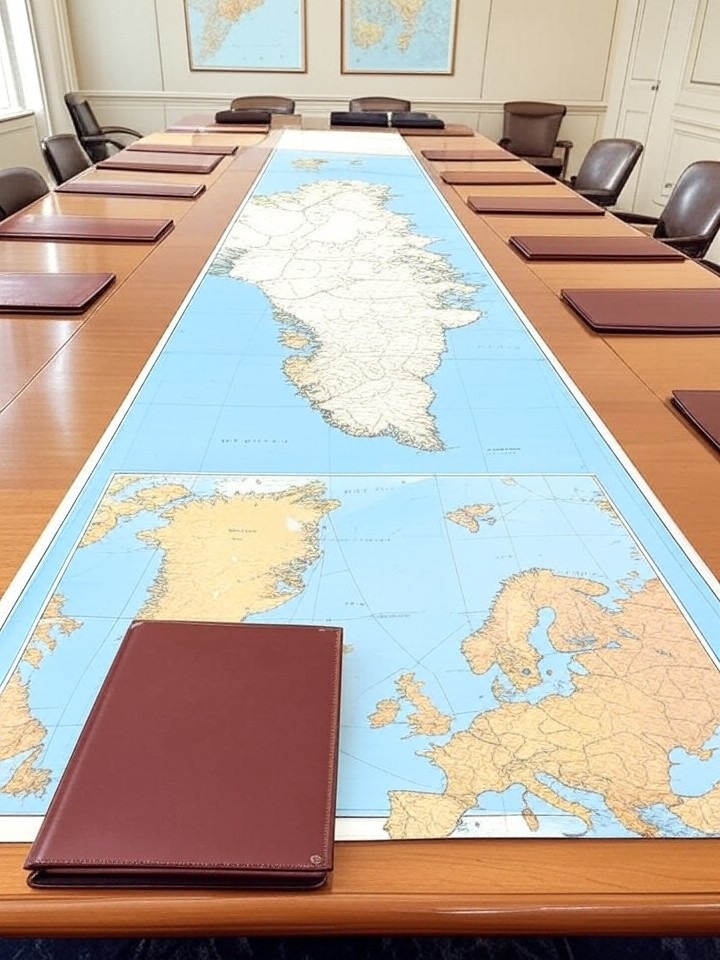
Illustration for: Danish and Greenlandic Officials Meet U.S. Administration Amid Dispute Over Sovereignty
AI-generated illustration. Visual interpretation does not represent real individuals or scenes.

Danish and Greenlandic Officials Meet U.S. Administration Amid Dispute Over Sovereignty

2026-01-14

The BareStory

Diplomatic officials from Denmark and Greenland convened with U.S. leadership in Washington, D.C., on Wednesday to address rising tensions regarding the status of Greenland. The delegation, led by Danish Foreign Minister Lars Løkke Rasmussen and Greenlandic Foreign Minister Vivian Motzfeldt, was scheduled to hold talks with U.S. Vice President JD Vance and Secretary of State Marco Rubio. The high-level meeting occurs as President Donald Trump reiterates his intent to bring the semi-autonomous territory under American control.

President Trump has publicly argued that U.S. sovereignty over Greenland is essential for national security and to counter geopolitical rivals in the Arctic. Ahead of the talks, the president stated on social media that any outcome resulting in less than U.S. control would be "unacceptable," having previously remarked that "one way or the other, we're going to have Greenland."

Officials in Copenhagen and Nuuk have unified in their rejection of the proposal. During a joint press conference on Tuesday, Greenlandic Prime Minister Jens-Frederik Nielsen affirmed that the territory chooses to remain within the Kingdom of Denmark. Danish Prime Minister Mette Frederiksen described the U.S. pressure as dangerous and warned that any military attack on Greenland would effectively dissolve the NATO alliance. In a show of solidarity, leaders from France, Germany, the United Kingdom, Italy, Spain, and Poland issued a joint statement declaring that "Greenland belongs to its people."

The situation has also prompted action within the U.S. Congress. Senators Lisa Murkowski and Angus King scheduled a meeting with the Danish ambassador to express opposition to the administration's stance. Lawmakers have discussed legislative measures, including war powers resolutions, to prevent the use of force against a NATO ally. This legislative push coincides with congressional scrutiny over a U.S. military operation in Venezuela that reportedly took place earlier in January.

Left Perspective

  • Sovereignty viewed as essential for security
  • Rejection of alternative outcomes
  • Determination to acquire the territory

Right Perspective

  • Affirmation of Greenland’s current status
  • Warnings regarding NATO stability
  • Broad legislative and diplomatic opposition

How it may affect me

As a U.S. reader: Escalating tensions with Denmark and European allies could threaten the stability of the NATO alliance, potentially altering U.S. national defense strategies and international security commitments.

Congress may introduce legislation to limit executive war powers and prevent military action against NATO allies, marking a potential shift in how foreign policy disputes are managed.

The administration asserts that acquiring Greenland is necessary to counter geopolitical rivals in the Arctic, positioning this move as a critical component of national security strategy.

Diplomatic relationships with key partners like the UK, France, and Germany may face strain as these nations have unified to oppose U.S. claims over the territory.

Read the story at