
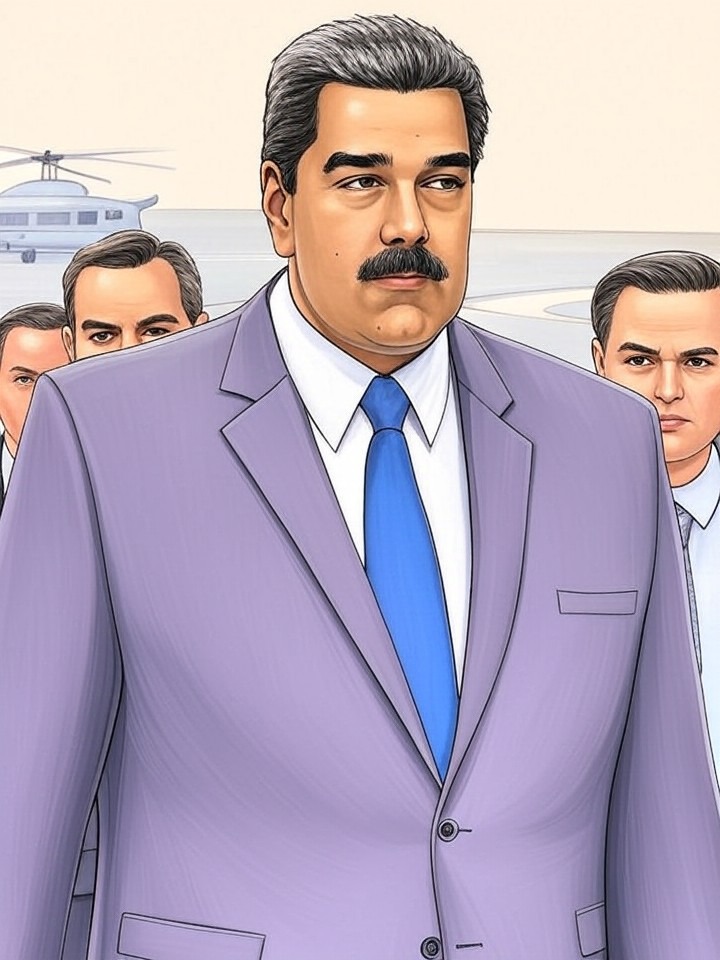
Illustration for: U.S. Military Operation Captures Venezuelan Leader Nicolás Maduro, Sparking Congressional Debate
AI-generated illustration. Visual interpretation does not represent real individuals or scenes.

U.S. Military Operation Captures Venezuelan Leader Nicolás Maduro, Sparking Congressional Debate

2026-01-04

The BareStory

A U.S. military operation ordered by President Donald Trump has resulted in the capture of Venezuelan leader Nicolás Maduro and his wife. The operation, which reportedly involved the Federal Bureau of Investigation (FBI) and the Drug Enforcement Administration (DEA), culminated in Maduro’s arrival at a New York heliport on January 3, where federal agents were present. President Trump stated that Maduro was apprehended in a "fortress-like house."

The intervention has drawn sharp divisions among U.S. lawmakers regarding its legality and strategic necessity. Republican supporters, including Rep. Dan Crenshaw and Sen. Tom Cotton, defended the action as a legitimate law enforcement measure against an indicted individual deemed a national security threat. Crenshaw cited historical precedents involving Manuel Noriega and Moammar Gadhafi, while Cotton argued that congressional notification was unnecessary for arresting indicted figures, likening the move to domestic law enforcement actions. House Foreign Affairs Committee Chairman Brian Mast dismissed concerns of a protracted conflict, asserting that the administration had carefully weighed the risks.

Conversely, the operation faces significant opposition from Democrats and some Republicans who question the administration's authority to act without congressional approval. Senate Majority Leader Chuck Schumer stated the administration violated assurances regarding legislative authorization, while Sen. Rand Paul and Rep. Thomas Massie argued the move bypassed Congress’s constitutional war powers. Sen. Chris Van Hollen described the action as an "invasion" involving American "boots on the ground," alleging the true motive was to seize Venezuelan oil rather than combat drug trafficking. Rep. Alexandria Ocasio-Cortez echoed these concerns, pointing to President Trump’s recent pardon of a convicted former Honduran president as evidence contradicting the administration's stated anti-drug rationale.

As Washington reacts to the operation, lawmakers are looking toward the future governance of Venezuela and potential legislative responses. Sen. Cotton warned that the United States must ensure the new Venezuelan government—which reportedly includes allies of the former regime—does not continue Maduro’s practices. Meanwhile, Sen. Van Hollen indicated that a vote on a war powers resolution could occur as early as this week, expressing concern that the intervention could complicate efforts to secure the release of Americans currently detained in the country.

Left Perspective

  • The operation is viewed as a legitimate law enforcement action against an indicted national security threat.
  • Historical precedents and risk assessments justify the executive branch's decision to act without prior legislative approval.
  • Focus must now shift to ensuring the new Venezuelan government breaks from the practices of the former regime.

Right Perspective

  • The intervention is challenged as an unauthorized violation of constitutional war powers and legislative assurances.
  • Lawmakers question the stated anti-drug rationale, alleging ulterior motives and highlighting policy contradictions.
  • There are concerns that the military action could endanger Americans currently held in Venezuela.

How it may affect me

As a U.S. reader:

Diplomatic efforts to secure the release of U.S. citizens currently detained in Venezuela may become more complicated or delayed due to the recent military intervention.

Congress may vote on a war powers resolution as early as this week, sparking a constitutional debate over the President's authority to authorize operations without legislative approval.

Federal courts in New York will likely handle high-profile legal proceedings following the Venezuelan leader's transfer to the custody of the FBI and DEA.

U.S. foreign policy will focus on vetting the new Venezuelan government to ensure that incoming leadership does not continue the practices of the former regime.

Read the story at