
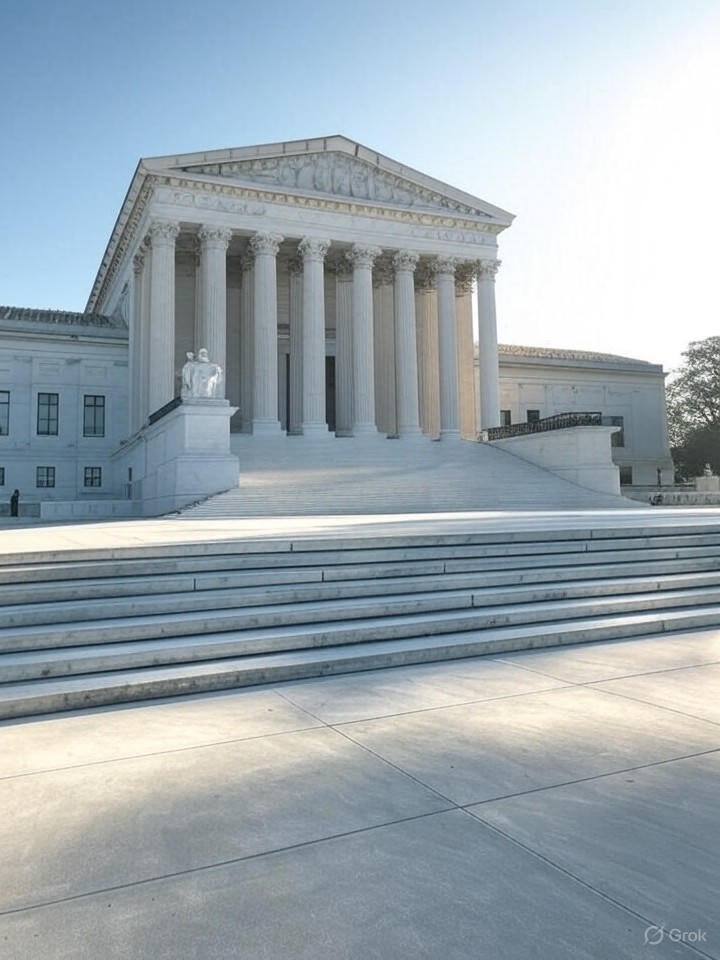
Supreme Court to Hear Arguments on Presidential Tariff Authority

Illustration for: Supreme Court to Hear Arguments on Presidential Tariff Authority
AI-generated illustration. Visual interpretation does not represent real individuals or scenes.

THE BARE STORY

The U.S. Supreme Court is scheduled to hear oral arguments on Wednesday in a case examining President Donald Trump’s authority to impose wide-ranging tariffs. The central issue is whether the president exceeded his powers under the International Emergency Economic Powers Act (IEEPA). The Justice Department is challenging two lower federal court rulings that found the tariffs were implemented without the proper legal authority.

On Sunday, President Trump announced he would not attend the court arguments, reversing a statement made in October. In a social media post, the president said he did not want to be a distraction from what he called one of the most consequential decisions before the court. He has stated that a president not being allowed to use tariffs would leave the country "defenseless." The tariffs at issue include "reciprocal tariffs" on most countries and separate "fentanyl tariffs" on certain imports from China, Canada, and Mexico.

Treasury Secretary Scott Bessent said on Tuesday that the administration is confident it will win the case. According to Bessent, while the IEEPA provides the "cleanest" authority, the administration has other "more cumbersome" but effective options if the court rules against it. He cited Section 232 of the Trade Expansion Act of 1962 and Section 301 of the Trade Act of 1974 as potential alternatives.

Separately, Secretary Bessent characterized a recent meeting in South Korea between President Trump and Chinese President Xi Jinping as "very good," stating it led to an agreement rolling back some tariffs between the nations. The Supreme Court hearing is one of several domestic challenges the president faces this week, which also include pivotal state elections and an ongoing government shutdown.

Same Facts. Different Perspectives.

Two AI models. Two viewpoints. One factual foundation.

• Two lower courts found the tariffs were improperly implemented. The case is before the Supreme Court because two lower federal courts previously ruled against the administration. Both of these prior rulings concluded that the tariffs at issue were implemented "without the proper legal authority," prompting the Justice Department to appeal.

• The legal challenge centers on the limits of a specific act. The "central issue" being examined by the Supreme Court is whether the president exceeded the powers granted to him under a specific law. The case focuses on the administration's use of the International Emergency Economic Powers Act (IEEPA) as the basis for its tariff actions.

• The Justice Department is appealing previous unfavorable rulings. The administration is in the position of challenging the previous legal outcomes in this case. The fact that the Justice Department is appealing to the Supreme Court shows that, up to this point, the judicial system has sided with the view that the president's actions were not properly authorized.

How it may affect me

As a U.S. reader:

• The court's ruling on tariff authority could directly affect the cost of consumer goods imported from China, Canada, Mexico, and other nations.

• This decision will clarify the president's power to set trade policy, potentially impacting the stability and predictability of U.S. tariffs on foreign goods.

• As specific "fentanyl tariffs" are part of the case, the outcome may affect how the government uses trade measures to address international drug trafficking.

Read the story at

Note: All TheBareNews content is AI-generated. For additional context, reporting, and updates, you are invited to explore the news outlets linked above.