
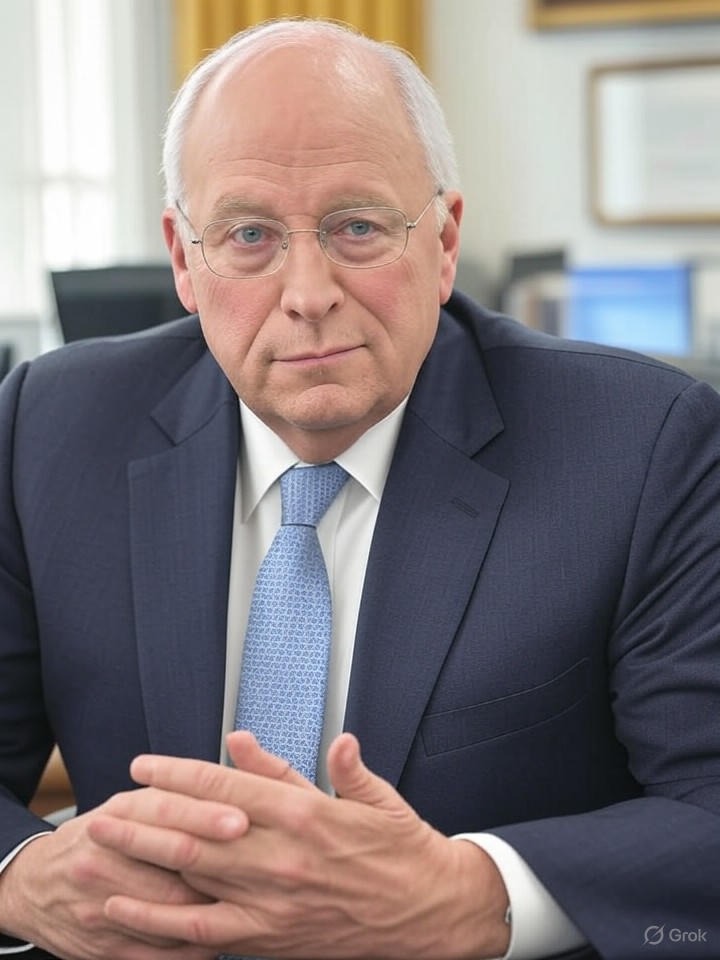
Illustration for: Former Vice President Dick Cheney Dies at 84
AI-generated illustration. Visual interpretation does not represent real individuals or scenes.

Former Vice President Dick Cheney Dies at 84

2025-11-04

The BareStory

Former Vice President Dick Cheney died on Monday night at the age of 84, his family announced. In a statement, the family said the cause was complications from pneumonia and cardiac and vascular disease. Cheney’s career in government spanned decades and included serving two terms as vice president under President George W. Bush, as secretary of defense for President George H.W. Bush, as a U.S. representative for Wyoming, and as White House chief of staff for President Gerald Ford.

Considered one of the most powerful vice presidents in U.S. history, Cheney was an influential adviser to President Bush and a key architect of the administration’s response to the September 11, 2001, attacks. He was a leading advocate for the 2003 invasion of Iraq, based on claims that Saddam Hussein possessed weapons of mass destruction, though none were ultimately found. In a statement, former President Bush described Cheney as a "calm and steady presence" who offered "honest counsel."

Cheney had a long history of cardiovascular health issues, suffering his first of five heart attacks at age 37 and undergoing a heart transplant in 2012. His career also included several controversies, including the 2006 accidental shooting of a hunting companion and the conviction of his chief of staff, Lewis "Scooter" Libby, for perjury in a CIA leak investigation. Libby was later pardoned by President Donald Trump.

In his later years, Cheney became a prominent Republican critic of Donald Trump. In an ad for his daughter Liz Cheney’s 2022 campaign, he called Trump the "greatest threat to the republic" in the nation’s history. In 2024, Cheney announced he had voted for a Democrat for president.

Left Perspective

  • He had a decades-long career in public service.
  • He was considered a uniquely powerful and influential vice president.
  • He was a central figure in the response to the 9/11 attacks.

Right Perspective

  • He was a leading advocate for the Iraq War based on unsubstantiated claims.
  • His career included significant controversies and legal issues involving his staff.
  • In his later years, he became a prominent critic of his own party's leader.

How it may affect me

As a U.S. reader:

• As a former official, his death is not expected to have any direct impact on current government policy, the economy, or the daily lives of the public.

Read the story at